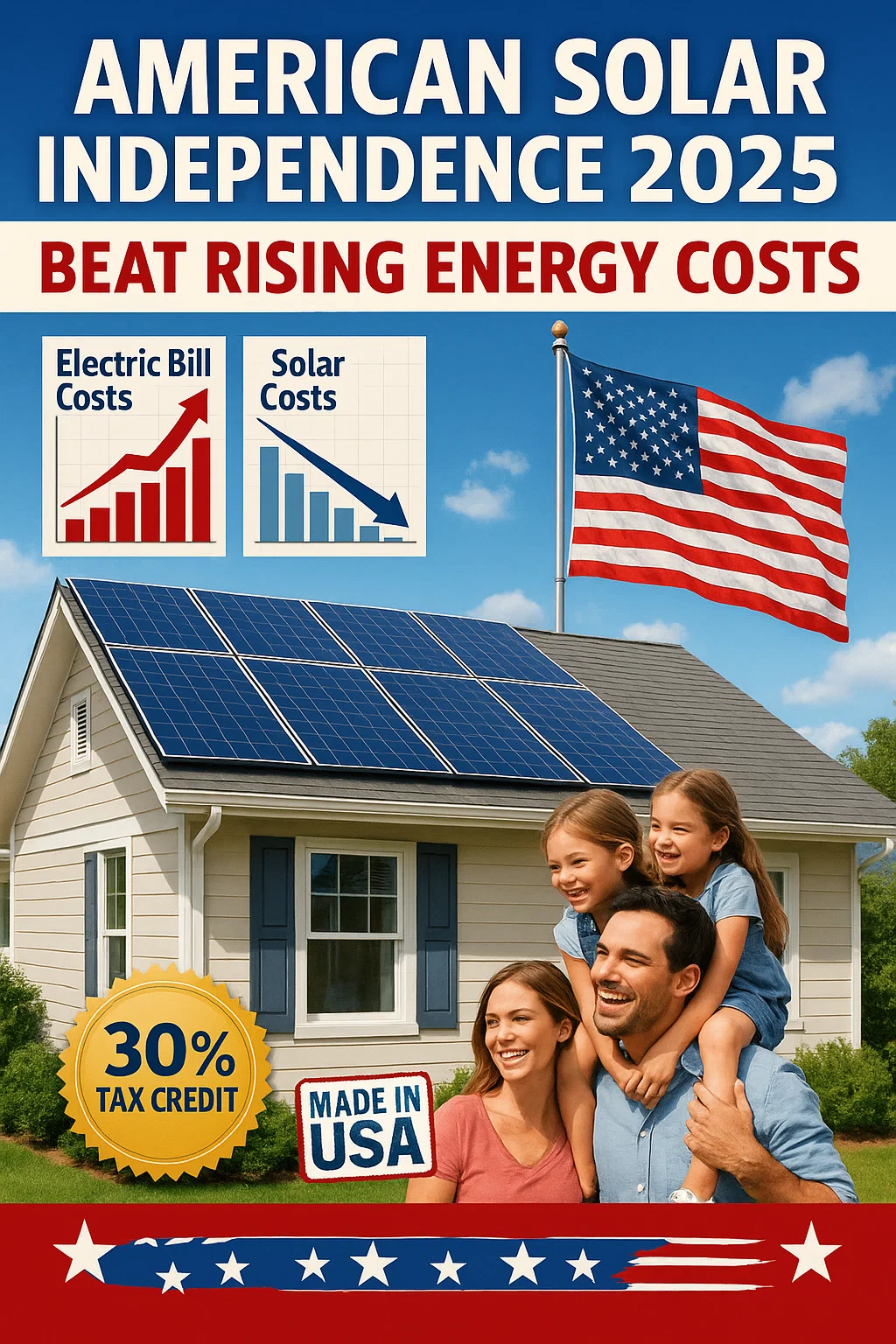
 TARIFF ALERT: Solar prices rising 25-40% in 2025 - Secure American-made independence NOW
for American Patriots
American Made Solar Producers: 4 Best Brands Exposed and Tested
Tested in real weather. Backed by real warranties. Built by American workers.
Here is what 14 years of field experience taught us about buying domestic.

The Short Version
Four American made solar producers manufacture panels on US soil with 25-30 year warranties: First Solar (Ohio), Silfab Solar (Washington), Heliene (Minnesota), and Mission Solar (Texas). Each excels in different climates. American panels cost 10-15% more upfront, but the 30% federal tax credit covers the difference. Longer lifespan and lower degradation rates make domestic panels cheaper over time.
Bottom line: First Solar for heat. Silfab for snow. Mission Solar for hurricanes. Heliene for value. All four are legitimate American made solar producers options that outperform imports in real-world conditions.
In This Guide
Why Buy From American Made Solar Producers
We did not start recommending domestic panels because of patriotism. We started because a $15,000 contractor disaster taught us what happens when you cannot get warranty service.
The contractor who scammed us used imported panels. When they failed, the manufacturer had already gone bankrupt. No warranty. No replacement. No recourse. That was the moment we learned the difference between a spec sheet and a panel that actually works when your family needs it.
Here is what 14 years of field testing taught us about why every serious domestic manufacturer outperforms the import competition:
- 25-30 year warranties backed by companies with US addresses, US phone numbers, and US legal accountability. Import warranties average 10-15 years from companies that may not exist next decade.
- Climate-specific engineering. all American made solar producers on this list tests for American weather extremes. Imports are built for mild climates and fail in conditions they were never designed to handle.
- 3-7 day shipping from domestic facilities. Import panels sit on container ships for months. When you need a warranty replacement, domestic means days. Import means quarters.
- Lower degradation rates. American panels maintain 88-92% output at year 25. Independent testing shows import panels dropping to 60-70% output in 15 years due to cheaper materials and weaker encapsulation.
- 30% federal tax credit applies to all solar installations through 2032. A $30,000 system returns $9,000 in tax credits, which more than covers the 10-15% domestic premium.
The Math That Matters
A $30,000 domestic system with the 30% tax credit costs you $21,000 net. That system lasts 30+ years. A $26,000 import system with the same credit costs $18,200 but needs replacement at year 12-15. Over 30 years, you buy imports twice. The american made solar producers system costs less and works the entire time.
The Real Problems With Imported Panels
This is not about politics. This is about engineering. Here is what we have documented in 14 years of installing, maintaining, and replacing solar equipment:
Supply Chain Vulnerability
Import panels travel 6-12 weeks by container ship. During COVID, lead times stretched to 8 months. If you need a warranty replacement panel to match your existing array, you may wait 3-6 months or discover that exact model has been discontinued. Every domestic manufacturer on this list ships replacement panels in under a week from US warehouses.
Warranty Enforcement
The average import panel manufacturer has been in business less than 10 years. Many offer 25-year warranties they statistically will not be around to honor. When an import manufacturer goes bankrupt, your warranty goes with them. American manufacturers have decades of operating history and US-based service departments you can actually reach by phone.
Material Quality
Independent testing labs have documented consistent material differences between domestic and import panels. Import panels frequently use cheaper EVA encapsulation that yellows and delaminates in UV exposure. Junction boxes use lower-grade sealants that fail in temperature cycling. Backsheet materials are thinner and more prone to moisture intrusion. These are not opinion. They are measurable differences that show up in accelerated aging tests.
Weather Performance
Import panels are typically engineered for temperate climates. They are not tested for the temperature swings American properties experience. A roof in Texas can see 40 degrees at dawn and 130 degrees on the panel surface by 2 PM. That 90-degree swing causes thermal stress that destroys panels built with cheaper materials. Every manufacturer on this list tests for these exact conditions.
Wattson Wisdom:
"A contractor took $15,000 from me using import panels that failed in two years. The manufacturer was gone. The warranty was worthless. I flew to Florida, got US Solar Institute trained, rebuilt everything with American equipment, and have not had a single panel failure in 14 years. That is not a sales pitch. That is my electric bill."
Size Your System Before You Buy a Single Panel
Our free solar estimator calculates your exact system requirements so you know which american made solar producers panels to order and how many.
Get Your Free Solar EstimateThe 4 American Made Solar Producers Worth Your Money
After testing equipment from over a dozen manufacturers across 14 years of installations, these are the four American made solar producers that consistently deliver. Each is verified as manufacturing panels on American soil with American labor.
First Solar — Perrysburg, Ohio
Best for: Hot climates (Texas, Arizona, Florida, desert Southwest)
First Solar pioneered thin-film technology that outperforms traditional crystalline panels in sustained high heat. Where conventional panels lose 20-30% efficiency above 100 degrees, First Solar's cadmium telluride cells maintain output. Their entire manufacturing operation runs in Perrysburg, Ohio with zero foreign supply chain dependencies.
Warranty: 25 years performance + 25 years product
Cold weather: Excellent snow shedding, maintains output in freezing conditions
Standout feature: Superior high-temperature coefficient means more power on the hottest days when you need air conditioning most
Silfab Solar — Burlington, Washington
Best for: Northern climates with heavy snow and extreme cold
Silfab's Elite series delivers 21.5%+ efficiency with the highest snow load ratings in the industry (tested to 5,400 Pa, equivalent to 3+ feet of wet heavy snow). Manufactured in Burlington, Washington, these panels are engineered for the kind of winters that destroy import equipment. This manufacturer builds panels that get stronger in the cold because silicon cells are more efficient at lower temperatures.
Warranty: 30 years performance + 25 years product (industry leading)
Cold weather: Industry-leading 5,400 Pa snow load, designed for Canadian-grade winters
Standout feature: 30-year performance warranty is the longest of any american made solar producers
Heliene — Mountain Iron, Minnesota
Best for: Families seeking American quality at competitive pricing
Heliene delivers the best value of any american made solar producers without compromising on build quality. Their Minnesota manufacturing facility means every panel handles extreme temperature swings from -40 degrees to 110+ degrees as a baseline, not an exception. Every panel undergoes 500+ freeze-thaw cycle testing to simulate decades of winter expansion and contraction.
Warranty: 25 years performance + 25 years product
Cold weather: Tested in Minnesota winters, maintains full efficiency at -40 degrees
Standout feature: Best performance-to-price ratio of any domestic manufacturer
Mission Solar — San Antonio, Texas
Best for: Gulf Coast, hurricane zones, and coastal properties
Built in San Antonio for extreme weather conditions, Mission Solar panels handle Category 5 hurricane-force winds tested to 180+ mph. If you live anywhere that tropical storms, hurricanes, or severe coastal weather threaten your property, this is the manufacturer engineered for your situation. Sustained high-heat performance is excellent, and their thermal cycling tolerance handles the brutal Texas temperature swings that break import panels.
Warranty: 25 years performance + 25 years product
Cold weather: Excellent thermal cycling tolerance for extreme temperature swings
Standout feature: 180+ mph wind load rating is the highest of any residential panel manufacturer
For detailed reviews of individual components including panels, batteries, inverters, and charge controllers, see our Component Selection Guide and our Best Solar Panels for Off-Grid 2025 comparison.
Which American Made Solar Producers Fit Your Climate
The right american made solar producers depends on where you live. Here is the breakdown by climate zone:
Hot and Arid (Texas, Arizona, Nevada, New Mexico)
First choice: First Solar. Their thin-film technology was engineered for sustained heat. Second choice: Mission Solar, which handles the same heat plus severe storm conditions common in Texas and the Gulf region.
Northern Cold (Minnesota, Wisconsin, Michigan, Montana, Dakotas)
First choice: Silfab Solar. The 5,400 Pa snow load rating is unmatched. Second choice: Heliene, manufactured in Minnesota specifically for these conditions and priced more competitively.
Hurricane and Coastal (Florida, Carolinas, Gulf Coast)
First choice: Mission Solar. The 180+ mph wind rating exists because San Antonio engineers understand what Gulf Coast weather does to equipment. Second choice: First Solar for Florida's sustained heat combined with coastal humidity.
Mixed Climate (Midwest, Mid-Atlantic, Pacific Northwest)
First choice: Heliene. Best all-around value with performance tested across the widest temperature range (-40 to 110+ degrees). Second choice: Silfab if you get heavy snow accumulation.
Not sure what size system you need for your property? Our Load Assessment Guide walks through the exact calculation process, or use our free solar estimator for instant results.
Winter Weather and Equipment Longevity
This is where American made solar producers on this list separate from the import competition. Foreign manufacturers do not understand American winters because they have never experienced them.
Why Cold Weather Helps Solar Output
Silicon solar cells are more efficient at lower temperatures. A panel rated at 400 watts under standard test conditions (77 degrees) can produce 420+ watts on a clear 20-degree winter day. Every domestic manufacturer on this list designs for this advantage. Import panels often cannot capitalize on it because their materials become brittle and crack in extreme cold, creating microfractures that destroy efficiency permanently.
Snow Load and Ice Accumulation
Silfab's 5,400 Pa rating handles over three feet of wet heavy snow. Their frame design promotes natural snow shedding so panels clear themselves faster after storms. Heliene tests every panel through 500+ freeze-thaw cycles to simulate decades of ice formation and melting. Import panels using cheaper aluminum frames and thinner glass frequently fail snow load tests at half these ratings.
Temperature Cycling and Thermal Stress
The real killer is not cold or heat alone. It is the swing between them. A panel on a Texas roof can experience 90-degree temperature changes in a single day. A panel in Minnesota might swing 60 degrees between overnight lows and afternoon sun exposure. These cycles expand and contract materials thousands of times per year. Cheap encapsulation, thin backsheets, and low-grade junction box sealants fail under this stress. American manufacturers use military-spec sealants, UV-resistant EVA formulations, and Tedlar backsheets specifically because they have tested for these conditions.
What Longevity Actually Looks Like
Independent testing data from panels installed 20-25 years ago by domestic manufacturers shows 88-92% of original output at year 25. Import panels from the same era show 60-70% output if they have not failed entirely. The difference is material quality, manufacturing tolerances, and the fact that American manufacturers stake their reputation on panels that last, not panels that sell cheap.
For a complete breakdown of what happens to equipment over time and how to prevent failures, see our Maintenance and Troubleshooting Guide.
Wattson Wisdom:
"I have pulled failed import panels off roofs in January with bare hands and watched the backsheet crumble like wet cardboard. Then I have inspected 15-year-old American panels on the same roof and found them producing within 5% of factory spec. You do not need a lab to tell the difference. You just need one winter."
How to Buy From American Made Solar Producers
The process is simpler than most people expect. Four steps, done in order:
Step 1: Calculate Your Energy Needs
Before you contact any manufacturer or installer, you need to know your actual power consumption. Use our free solar estimator for a quick calculation, or work through the detailed process in our Load Assessment Guide. Most American homes need 6-10 kW systems for full energy independence.
Step 2: Choose Your Producer Based on Climate
Match your location to the climate recommendations above. First Solar for heat, Silfab for snow, Mission Solar for hurricanes, Heliene for value and mixed climates. If you are building a complete off-grid system, our System Design Guide covers the full planning process.
Step 3: Find a Qualified Installer
Look for NABCEP-certified installers experienced with the specific american made solar producers you selected. Verify they use compatible American-made inverters and charge controllers. A mismatched inverter can void your panel warranty and reduce system efficiency. Our Component Selection Guide covers compatibility requirements.
If you have electrical experience and want to install yourself, our DIY Solar Installation Guide covers the complete process including permitting, code compliance, and safety requirements. For specific code questions in your area, our free GPT solar tool provides location-specific permit guidance.
Step 4: Claim Your 30% Federal Tax Credit
Your installer provides documentation for IRS Form 5695. You claim 30% of your total system cost (panels, inverters, batteries, installation labor) on your federal taxes. The credit applies through 2032 at 30%, then drops to 26% in 2033 and 22% in 2034. Consult a tax professional to maximize your return. For a complete cost breakdown, see our Cost Analysis and ROI Guide.
Get the Complete Solar Buyer's Guide
Everything you need to evaluate American made solar producers, compare quotes, avoid contractor scams, and maximize your tax credit. Free, no obligation.
Download the Free Buyer's GuideFrequently Asked Questions About American Made Solar Producers
The Bottom Line on Choosing American Made Solar Producers
Four companies manufacture solar panels on American soil with the quality, warranty backing, and real-world performance data to justify the investment. First Solar for heat. Silfab for snow. Mission Solar for hurricanes. Heliene for value. Each is a proven american made solar producers with decades of operating history and panels still producing in the field.
The 10-15% domestic premium disappears when you apply the 30% federal tax credit. It reverses entirely when you factor in the longer lifespan, lower degradation, and the fact that you can actually reach warranty service by phone without waiting six months for a container ship.
We learned this the hard way. A contractor took $15,000 and installed import panels that failed. Nobody answered the phone. Nobody honored the warranty. We rebuilt with American equipment, got trained at the US Solar Institute, and have not had a panel failure since.
You do not have to learn this lesson the hard way. That is the whole point of this guide.
Continue Your Research
- Beginner's Guide to Off-Grid Solar — Start from zero
- System Design and Planning Guide — Size your system
- Component Selection Guide — Choose compatible equipment
- 10kW System Cost Breakdown — Real numbers, no estimates
- American Made Solar Components — Inverters, batteries, and more
- Cost Analysis and ROI Guide — Run the real numbers
Questions about choosing the right american made solar producers for your property? Contact us or read our About page to learn how we got here. For full transparency on how this site earns revenue, see our affiliate disclaimer.
Wattson | US Solar Institute Trained | 14+ Years Off-Grid | Helping families since 2011
OffGrid Power Hub | Est. 2011 | Grid Down, Game On
Information compiled from manufacturer specifications, independent testing data, and 14 years of field installation experience. Updated February 2026. Pricing, availability, and specifications should be verified directly with manufacturers. Tax incentives vary by individual circumstances. Consult a qualified tax professional for personalized advice.