 TARIFF ALERT: Solar prices rising 25-40% in 2025 - Secure American-made independence NOW
for American Patriots
Solar Tax Credit: Claim 30% Back Before 2032
The federal solar tax credit pays you 30% of your system cost. Every dollar on panels, batteries, inverters, and installation labor.
Trusted by families who ran the numbers before writing the check.
Quick Answer: The federal solar tax credit gives you 30% of total system cost back on your taxes through 2032. A $30,000 system means $9,000 back. A $50,000 system means $15,000 back. File IRS Form 5695 with your return. DIY installs qualify on equipment costs. Batteries qualify when solar-charged. This credit is a dollar-for-dollar tax reduction, not a deduction.
Bottom Line Up Front
+The credit: 30% of total solar system cost. Through December 31, 2032.
What qualifies: Panels, inverters, batteries, charge controllers, wiring, mounting hardware, professional labor, permits, and sales tax on equipment.
DIY rule: Equipment costs qualify. Your own labor does not.
The trap: This is a tax credit, not a rebate. You must owe taxes to use it. Unused credit carries forward indefinitely.
The deadline: System must produce power by December 31 of the tax year. Miss it by one day and you wait a full year.
Stack it: Combine federal with state incentives. Some families save 50-60% of total cost.
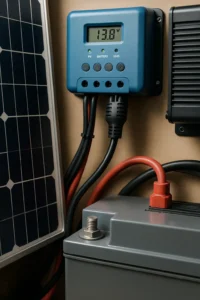
The 30% solar tax credit applies to every component in your system.
Complete Solar Tax Credit Guide
+- Federal Solar Tax Credit (ITC) Explained
- What Qualifies and What Does Not
- How to Claim: Forms and Documentation
- DIY Installation and the Solar Tax Credit
- Battery Storage Tax Credit Rules
- State Incentives Worth Thousands
- Stacking Multiple Incentives
- Mistakes That Cost Families Thousands
- Business and Agricultural Solar Credits
- Common Questions
Key Numbers for Solar Buyers
- 30%: Federal solar tax credit rate through 2032
- $9,000: Credit on a $30,000 system
- $15,000: Credit on a $50,000 system
- 26%: Reduced rate starting 2033
- $0: Residential credit after 2034
Source: IRS.gov, Inflation Reduction Act of 2022, U.S. Department of Energy
Federal Solar Tax Credit: 30% Through 2032
The solar tax credit is the biggest incentive available. The federal government gives you 30% of your total system cost back. Not a deduction. A dollar-for-dollar tax credit.
A $30,000 system puts $9,000 back in your pocket. A $50,000 system returns $15,000. That is real money. Yours. Not the government's.
| Install Year | Solar Tax Credit Rate | Value on $30K | Value on $50K |
|---|---|---|---|
| 2025-2032 | 30% | $9,000 | $15,000 |
| 2033 | 26% | $7,800 | $13,000 |
| 2034 | 22% | $6,600 | $11,000 |
| 2035+ | 0% (Residential) | $0 | $0 |
Timing Is Everything
Waiting until 2033 costs you $2,000 on a $50,000 system. Waiting until 2035 costs the entire $15,000. Every year you delay, the solar tax credit shrinks.
Solar Tax Credit: What Qualifies
The ITC covers more than just panels. Every component of your system qualifies. So does professional installation labor.
Eligible Equipment and Costs
Solar panels and racking. Inverters and charge controllers. Battery storage systems. Electrical wiring and components. Monitoring equipment. Ground mount foundations. Professional installation labor. Permit fees. Sales tax on equipment.
What Does Not Qualify
Your own labor on DIY installs. General-purpose tools. Transportation costs. Roof repairs not related to solar. Landscaping or tree removal. Used or refurbished equipment.
Food for Thought
The rancher who spent $45,000 on a complete off-grid system got $13,500 back on his taxes. That covered his entire battery bank. His neighbor leased panels instead. His neighbor got nothing. Ownership wins. Every single time.
How to Claim the Solar Tax Credit
Filing is straightforward. Three IRS forms. Proper documentation. Careful timing.
Required IRS Forms
Form 5695: Residential Energy Credits. This is your main solar tax credit form. Form 1040: Your individual tax return. Schedule 3: Additional Credits and Payments. Transfers your credit to the return.
Documentation to Keep (7 Years)
Every equipment receipt and invoice. Installation labor invoices. Permit documentation. Manufacturer certifications. Installation photos: before, during, and after. Performance data proving the system operates. Financing agreements if applicable.
Operational Deadline
Your system must produce power by December 31 of the tax year. Installed in December but not operational until January? You wait a full year to claim the solar tax credit. Plan accordingly.
Professional tax help costs $300-800. Worth it for systems over $30,000 or complex situations. The cost is a fraction of what one mistake loses you.
Free Solar ROI Calculator
Calculate your exact solar tax credit savings. Factor in state incentives. See your true payback period.
Calculate Your Solar SavingsTrusted by families who ran the numbers before writing the check.
DIY Installation and the Solar Tax Credit
Good news for DIY builders. Self-installed systems qualify. But the rules differ from professional installs.
What counts: All equipment costs. Permits and fees. Professional electrical connections you hire out. Materials and supplies. Tool rental specific to the project.
What does not count: Your own labor. General tool purchases. Transportation. Training costs. Lost wages from time off work.
A $30,000 DIY system with $25,000 in equipment and $5,000 in hired electrical work qualifies the full $30,000 for the credit. That is $9,000 back.
See our DIY vs Professional Installation Cost Comparison for detailed savings analysis.
Battery Storage and the Solar Tax Credit
Battery storage qualifies. This is a game-changer for off-grid patriots.
100% solar-charged batteries: Full solar tax credit. Off-grid systems always qualify because batteries charge only from solar.
Mixed charging (grid + solar): Only the solar percentage qualifies. Track your charging sources carefully.
Retrofit batteries: Adding storage to existing solar? The battery cost qualifies. Even years after your original install.
Wattson's Take on Battery Credits
"Your battery bank is the most expensive single component. The ITC makes it 30% cheaper. That is $3,000-6,000 back on a serious battery setup."
Off-grid systems get the full credit on every battery. No questions about grid charging. No mixed-use calculations. Pure solar. Full credit. Done.
State Solar Tax Credit and Incentives
State incentives stack on top of federal. Some states add thousands more in savings.
| Incentive Type | How It Works | Typical Value |
|---|---|---|
| Cash Rebates | Direct payment per watt installed | $0.50-2.00/watt |
| State Tax Credits | Separate state credit (stacks with federal) | 10-25% of cost |
| Sales Tax Exemption | No sales tax on solar equipment | 5-10% savings |
| Property Tax Exemption | Solar does not increase property tax | Varies by value |
| Performance Payments | Paid per kWh produced (SRECs) | $0.05-0.30/kWh |
Search the DSIRE database for renewable energy incentives in your state. It is the most comprehensive database of renewable energy incentives in the country.
For state-specific legal requirements, use our Solar Intel GPT tool with your zip code for exact permit and incentive information.
Stacking Solar Tax Credit with Other Incentives
The real savings come from stacking. Federal. State. Local. Utility. All at once.
| Incentive Layer | Typical Savings | Example on $40K System |
|---|---|---|
| Federal Solar Tax Credit (30%) | 30% | $12,000 |
| State Tax Credit (15%) | 10-25% | $6,000 |
| Utility Rebate | $500-5,000 | $2,000 |
| Sales Tax Exemption | 5-10% | $2,800 |
| TOTAL SAVINGS | 50-60% | $22,800 |
That $40,000 system costs $17,200 after all incentives. The federal credit alone saves $12,000. Stack everything available and the system nearly pays for itself.
Food for Thought
The electrician in Arizona stacked federal, state, and utility incentives. His $35,000 system cost $14,000 out of pocket. His monthly utility bill before: $280. His bill now: $0. Payback in 4.2 years. After that, every dollar is pure savings. For 25 more years.
Free Solar Buyer's Guide
Every incentive, every form, every deadline. One download. Stop leaving money on the table.
Download Free Buyer's GuideTrusted by budget-conscious homesteaders who invest wisely.
Solar Tax Credit Mistakes That Cost Thousands
These errors are common. Every one costs real money.
Mistake 1: Leasing instead of owning. You lose the entire 30% ITC. The leasing company gets it. You get nothing.
Mistake 2: Missing the December 31 deadline. System installed but not operational? No ITC that tax year. You wait 12 months.
Mistake 3: Not planning for tax liability. The credit only offsets taxes you owe. $15,000 credit means nothing if you owe $0 in taxes.
Mistake 4: Poor documentation. No receipts means no proof in an audit. Keep everything 7 years. Photos. Invoices. Permits. Every scrap of paper.
Mistake 5: Ignoring state incentives. The federal solar tax credit is just the starting point. Thousands more sit in state programs unclaimed because nobody looked.
Wattson's Warning on Leases
"A lease sounds easier. No money down. Low monthly payments. But you just gave away $9,000-15,000 in federal credits."
The leasing company keeps your credit. They marked up the system cost. They own the equipment on your roof. You own nothing. You save less. Own your system. Build real independence.
Business and Agricultural Solar Tax Credit
Business installations unlock additional tax benefits beyond the standard ITC.
MACRS Depreciation: 5-year accelerated depreciation. Additional 20-30% in tax savings on top of the 30% credit.
Bonus Depreciation: 100% first-year depreciation available through 2027. Massive tax reduction in year one.
USDA REAP Grants: Up to 50% of project costs for rural businesses and agricultural operations. Stacks with the federal ITC.
Section 179 Deduction: Immediate equipment deduction up to $1.16 million in 2025. Applies to solar equipment.
Business solar incentive planning requires a CPA familiar with renewable energy. The complexity pays for itself many times over. Consult with a professional before making decisions.
What the Authorities Say
"The Residential Clean Energy Credit equals 30% of the costs of new, qualified clean energy property installed from 2022 through 2032."
Internal Revenue Service, IRS.gov"The average residential solar installation in the U.S. costs approximately $2.75 per watt before incentives, making the ITC worth $4,125-8,250 on typical systems."
U.S. Department of Energy, Energy.gov"Solar installations increased 51% year-over-year following expansion of the Investment Tax Credit under the Inflation Reduction Act."
Solar Energy Industries Association, SEIA.org
Main Takeaway
The 30% federal ITC is the largest incentive available for energy independence. It covers panels, batteries, inverters, wiring, labor, and permits. File Form 5695. Keep records 7 years. Stack with state incentives for 50-60% total savings.
The credit drops to 26% in 2033. Gone for residential after 2034. Every year you wait costs money. Own it. Claim it. Break free from utility control.
Solar Tax Credit FAQ
+What is the federal solar tax credit?
+The federal solar tax credit (ITC) gives you 30% of total system cost back as a tax credit. For a $30,000 system, that is $9,000 back. It applies through 2032 and drops to 26% in 2033.
How do I claim the solar tax credit?
+File IRS Form 5695 with your tax return. Attach to Form 1040 with Schedule 3. Keep all receipts, permits, and photos for 7 years.
Does DIY solar qualify for the tax credit?
+Yes. Equipment costs, permits, and hired electrical work qualify. Your own labor does not count toward the credit amount.
Do batteries qualify for the solar tax credit?
+Yes. Battery storage qualifies when charged by solar. Off-grid batteries get the full 30%. Grid-tied batteries with mixed charging qualify only for the solar percentage.
What if my tax liability is less than the credit?
+Unused credit carries forward indefinitely. If you owe $8,000 and have a $15,000 credit, use $8,000 this year and carry $7,000 to next year.
When does the solar tax credit expire?
+30% through 2032. Drops to 26% in 2033, 22% in 2034. Residential credit expires completely after 2034. Commercial keeps 10% permanently.
Can I claim it on a second home?
+Yes. Primary and second homes you own qualify. Rental properties use business tax rules (MACRS depreciation). Leased systems do not qualify.
What state solar incentives are available?
+State incentives include cash rebates, tax credits, sales tax exemptions, and property tax exemptions. Search the DSIRE database at dsireusa.org for your state.
Can I stack federal and state incentives?
+Yes. Federal and state incentives stack. Combine the 30% federal credit with state rebates, utility programs, and local incentives. Some save 50-60% total.
Do solar leases qualify for the tax credit?
+No. The leasing company claims the credit. You lose the entire 30%. Ownership is always better for claiming the ITC.
Calculate Your Exact Solar Tax Credit Savings
See how much the 30% credit saves you. Factor in state incentives. Know your true cost before you build.
Get Your Free ROI CalculatorLast Updated: February 2026 | Sources: IRS.gov, Energy.gov, SEIA.org, DSIRE | Originally published January 2025