 TARIFF ALERT: Solar prices rising 25-40% in 2025 - Secure American-made independence NOW
for American Patriots
Solar Oven: 5 Selection Mistakes That Waste Your Money
Cook hot meals without fuel, propane, or electricity. When the grid goes down and you've burned through your stored fuel, the sun keeps shining. This guide covers the selection mistakes that waste money on underpowered cookers and which models actually work for serious off-grid cooking.

TL;DR: Quick Summary (Click to Expand)
+Solar Oven Selection Summary:
- For fast cooking + portability: Tube-style parabolic designs (20-minute meals, 550°F max).
- For family meals + traditional cooking: Box-style ovens (2-3 hour meals, 400°F max).
- For budget builds: Panel cookers deliver solid performance at lower cost.
- Price range: $50-400 depending on design and quality.
- Lifespan: Quality models last 15-20+ years with minimal maintenance.
Key insight: A unit reaches 250-550°F without fuel. Cooking takes 2-3x longer than conventional methods but costs nothing to operate and works indefinitely during emergencies.
Your neighbor burned through three propane tanks in the first week of the extended outage. When he finally ran out, he was eating cold beans from a can while you were pulling hot bread from your cooker. The sun showed up every day of that crisis, just like it has for 4.5 billion years. That's the kind of cooking fuel reliability worth investing in.
What's in This Guide (Click to Expand)
+🍳 Free Off-Grid Cooking Guide
Get our complete guide to cooking without grid power. Covers solar ovens, rocket stoves, propane systems, and emergency cooking methods.
Get Cooking Guide5 Solar Oven Selection Mistakes That Waste Your Money
These mistakes cost buyers hundreds of dollars on models that underperform or fail to meet their needs. Avoid them and your investment pays back for decades.
Mistake #1: Buying Based on Maximum Temperature Claims
Marketing departments love to advertise peak temperatures achieved under perfect laboratory conditions. A solar oven rated at 400°F might only reach 300°F in real-world use with partial clouds or lower sun angles. Focus on average cooking temperatures and user reviews from your climate zone instead of theoretical maximums.
Mistake #2: Ignoring Cooking Capacity Needs
That compact tube-style model looks sleek and portable. It also only cooks 2-3 servings at a time. If you're feeding a family of six during an extended outage, you'll spend all day cooking in shifts. Match your cooker capacity to your actual household size and meal requirements.
Mistake #3: Choosing Portability Over Performance
Ultralight models fold flat and weigh almost nothing. They also struggle to maintain cooking temperatures and require constant repositioning. Unless you're backpacking, prioritize thermal performance and insulation over packability. A model that sits in your backyard needs to cook efficiently, not win ultralight competitions.
Mistake #4: Skipping Durability Considerations
Cheap cookers use thin reflective materials that degrade in UV light within a year or two. Quality models use durable reflectors rated for decades of outdoor exposure. A $50 solar oven that needs replacement every two years costs more than a $300 model that lasts 20 years.
Mistake #5: Buying Without Understanding Your Climate
A model that performs well in Arizona might struggle in the Pacific Northwest. If you live in a cloudy climate, you need a design optimized for lower light conditions. Parabolic concentrators outperform box designs in marginal sunlight. Know your average sunny days before selecting your cooker model.
🦶 Wattson's Wisdom: "The Sun Never Runs Dry"
"I've watched families burn through their propane reserves in the first week of an extended outage. Meanwhile, my unit kept cooking every sunny day. When you're planning for real emergencies, you need cooking methods that don't depend on resupply. The sun has been showing up for 4.5 billion years. That's the kind of reliability I trust for my food security."
What is a Solar Oven?
It uses reflective surfaces and insulated chambers to concentrate sunlight into cooking heat. Quality models reach 250-400°F, with some parabolic designs hitting 550°F. That's hot enough to bake bread, roast meat, sterilize water, and cook anything you'd make in a conventional oven.
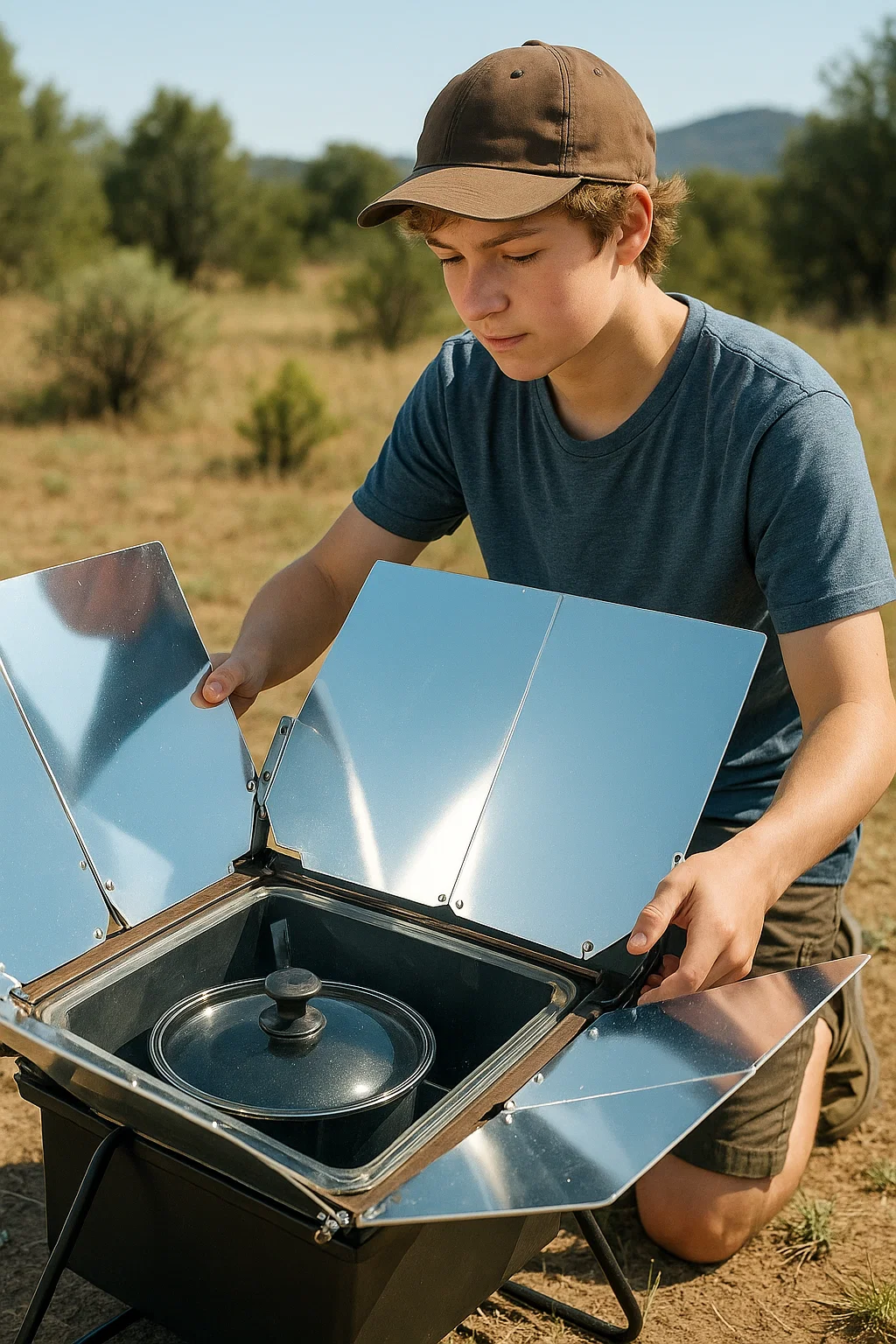
How a unit works: Reflective panels focus sunlight into a cooking chamber. Glass or plastic covers trap the heat inside (greenhouse effect). Dark cookware absorbs heat efficiently. The result: oven-temperature cooking powered entirely by the sun with zero fuel costs.
According to U.S. Department of Energy research, solar cookers can reach temperatures sufficient for pasteurization and safe food preparation, making them viable alternatives to fuel-based cooking in appropriate climates.
Why Every Off-Gridder Needs a Solar Oven
No fuel dependency. Propane runs out. Firewood requires labor. It uses free, unlimited energy during daylight hours.
Zero operating costs. After the initial purchase, every meal is free. No ongoing fuel expenses, no replacement parts, no consumables for your cooker.
Emergency insurance. When supply chains break and stores empty out, your cooker keeps cooking. It's the only cooking method that works indefinitely without resupply.
Safe unattended cooking. Unlike fire-based cooking, you can leave a solar oven working while you handle other tasks. No fire risk, no smoke, no babysitting required.
Long-term investment. Quality models last 15-20+ years. Divide the purchase price over decades of use and the per-meal cost becomes negligible.
Think about what happens when propane deliveries stop. Your stored fuel has an expiration date measured in weeks or months. The sun doesn't care about supply chains, truck driver shortages, or fuel prices. A solar oven gives you the ability to cook hot meals for your family indefinitely, with no ongoing costs and no dependence on anyone else. That's real independence.
Solar Oven Types Compared
| Type | Max Temp | Cook Time | Capacity | Best For |
|---|---|---|---|---|
| Box Style | 350-400°F | 2-3 hours | Family meals | Homesteaders |
| Parabolic Tube | 450-550°F | 20-60 min | 2-4 servings | Campers, speed |
| Panel Cooker | 250-300°F | 3-4 hours | Medium meals | Budget buyers |
| Hybrid/Portable | 275-325°F | 2-3 hours | Small meals | Backpackers |
Box-Style Solar Oven
The workhorse of solar cooking. Box-style models function like a conventional oven with a hinged door, insulated walls, and reflective panels. They accept standard cookware and reach temperatures suitable for baking, roasting, and slow cooking. Heavier and less portable but most versatile for family cooking needs.
Parabolic Tube Solar Oven
Uses a curved reflector to concentrate sunlight onto a tube-shaped cooking chamber. Reaches the highest temperatures and cooks fastest. Limited capacity and unusual shape restricts what you can cook. Ideal for quick meals and situations requiring fast cooking times.
Panel Cooker Solar Oven
Simple reflective panels focus sunlight onto a cooking pot inside a transparent bag or dome. Lowest cost and simplest design. Lower temperatures and longer cooking times. Good entry point for beginners or budget-conscious preppers.
🥫 Free Emergency Food Supply Guide
It is only part of your food security system. Get our complete guide to long-term food storage that pairs with your cooking capabilities.
Get Food Storage GuideTop Solar Oven Models Reviewed
1. All-American Sun Oven (Box Style)
The All-American Sun Oven is the workhorse of solar cooking. It functions like a conventional oven, reaching 400°F with a large cooking chamber that fits standard pots and pans. Built in the USA with a 25+ year track record. This is the model serious homesteaders choose for family meal preparation.
Best for: Families, homesteaders, and anyone who wants traditional oven-style cooking from their unit.
Pros:
- Large capacity for family meals
- Reaches 400°F for baking and roasting
- Accepts standard cookware
- Extremely durable, 25+ year lifespan
- Made in USA
Cons:
- Heavier and bulkier than portable models
- Higher price point ($300-400)
- Requires repositioning every 1-2 hours
2. GoSun Sport (Parabolic Tube)
The GoSun Sport uses a parabolic tube design to reach temperatures up to 550°F. It's the fastest-cooking model on the market, handling meals in as little as 20 minutes. The compact design weighs just 7 pounds and works even in partly cloudy conditions.
Best for: Solo users, campers, and anyone who needs fast solar cooking in a portable package.
Pros:
- Fastest solar cooking available (20-minute meals)
- Works in partly cloudy conditions
- Extremely portable at 7 pounds
- Durable, weather-resistant construction
Cons:
- Limited capacity (2-3 servings)
- Tube shape limits what you can cook
- Higher price point ($250-350)
3. Haines 2.0 Solar Cooker (Panel Style)
The Haines 2.0 delivers solid performance at a budget-friendly price. It includes a 4-quart Dutch oven and reaches temperatures around 350°F. Simple reflective panel design is easy to assemble and store.
Best for: Budget-conscious buyers, beginners, and backup emergency solar cooking.
Pros:
- Excellent value for money ($50-80)
- Includes cooking pot
- Lightweight and compact
- Simple setup
Cons:
- Lower maximum temperature (350°F)
- Less durable than premium models
- Requires good sunlight conditions
🦶 Wattson's Wisdom: "Practice Before You Need It"
"The worst time to learn solar cooking is during an emergency. Buy your cooker now. Use it on weekends. Figure out what works and what doesn't while you still have backup options. When the grid goes down and you're cooking your first solar meal, you want confidence, not a learning curve. Practice makes perfect, and perfect makes full stomachs."
Solar Oven Cooking Tips for Best Results
Start early. Solar oven cooking takes 2-3 times longer than conventional methods. Plan to start meals by 10am for lunch or early afternoon for dinner.
Preheat your cooker. Set up 15-30 minutes before adding food. A preheated chamber cooks more efficiently.
Use dark, thin cookware. Black or dark enamel pots absorb heat better than shiny surfaces. Thin walls transfer heat faster than thick cast iron in your cooker.
Reposition every hour. For best results, adjust your cooker to track the sun every 60-90 minutes. Some designs hold temperature longer without adjustment.
Don't peek. Every time you open the lid, you lose 10-15 minutes of cooking time. Trust the process and check less frequently than you would with a regular oven.
Essential Solar Oven Accessories
- Dark Cookware: Granite-ware or dark enamel pots maximize heat absorption in your cooker.
- Oven Thermometer: Monitor internal temperatures to know when your cooker is ready.
- Carrying Case: Protect your investment during transport and storage.

Frequently Asked Questions (Click to Expand)
+Recommended Emergency Cooking Supplies
A unit works best as part of a complete off-grid cooking system. Here are complementary products we personally use and recommend:
- Long-Term Food Storage: Emergency food supplies that pair with solar cooking for true food independence.
- Food Preservation Equipment: Food preservation kits to store your solar-cooked meals.
- Pressure Canner: All American Pressure Canner for preserving meats and vegetables.
Your Food Independence Starts Now
When the supply chain breaks and the grocery stores empty out, you'll be cooking hot meals while others scramble. It is insurance that never expires and costs nothing to operate. Stop depending on fuel supplies. Start cooking with the sun.
Get Complete Food Security Guide🤖 Got Specific Questions?
Get personalized answers about selection, cooking techniques, and off-grid food preparation for your specific situation.
Use Free GPT AssistantDisclosure: We only recommend products we personally use in our own off-grid cooking systems. Some links are affiliate partnerships that help support this site at no cost to you.