
Energy Independence
for American Patriots
for American Patriots
TARIFF ALERT: Solar prices rising 25-40% in 2025 - Secure American-made independence NOW
Join 5,000+ energy-independent patriots who've stopped depending on the failing grid
To fix low solar output, you need systematic testing with a multimeter. Most problems come from corroded MC4 connectors, thermal throttling, or panel damage.
Key insight: 90% of issues are fixable with basic diagnostic tools under $200. Master how to fix low solar output yourself, or freeze when it matters most.
Learning to fix low solar output saved my family during a Montana winter crisis. Ten below zero. Wind chill pushing minus thirty. Morning revealed three feet of snow and a system producing 40% capacity.
No heat. No power for communication. Battery bank draining fast.
Nearest help was twenty miles through drifts. I had maybe eight hours before things got dangerous. This wasn't inconvenience. This was survival.
No utility company to call. No backup grid. Just me, failing equipment, and Montana winter. I needed to fix low solar output fast. Or freeze.
Six months earlier, everything worked perfectly. Sixteen 390-watt panels. Premium MPPT controller. 48V lithium bank with 20kWh capacity. Twenty percent overcapacity. I thought I'd built bulletproof.
I was wrong.
Knowing how to fix low solar output became survival training. Not optional. Systems don't fail catastrophically. They degrade in patterns. And I'd been ignoring the signs.
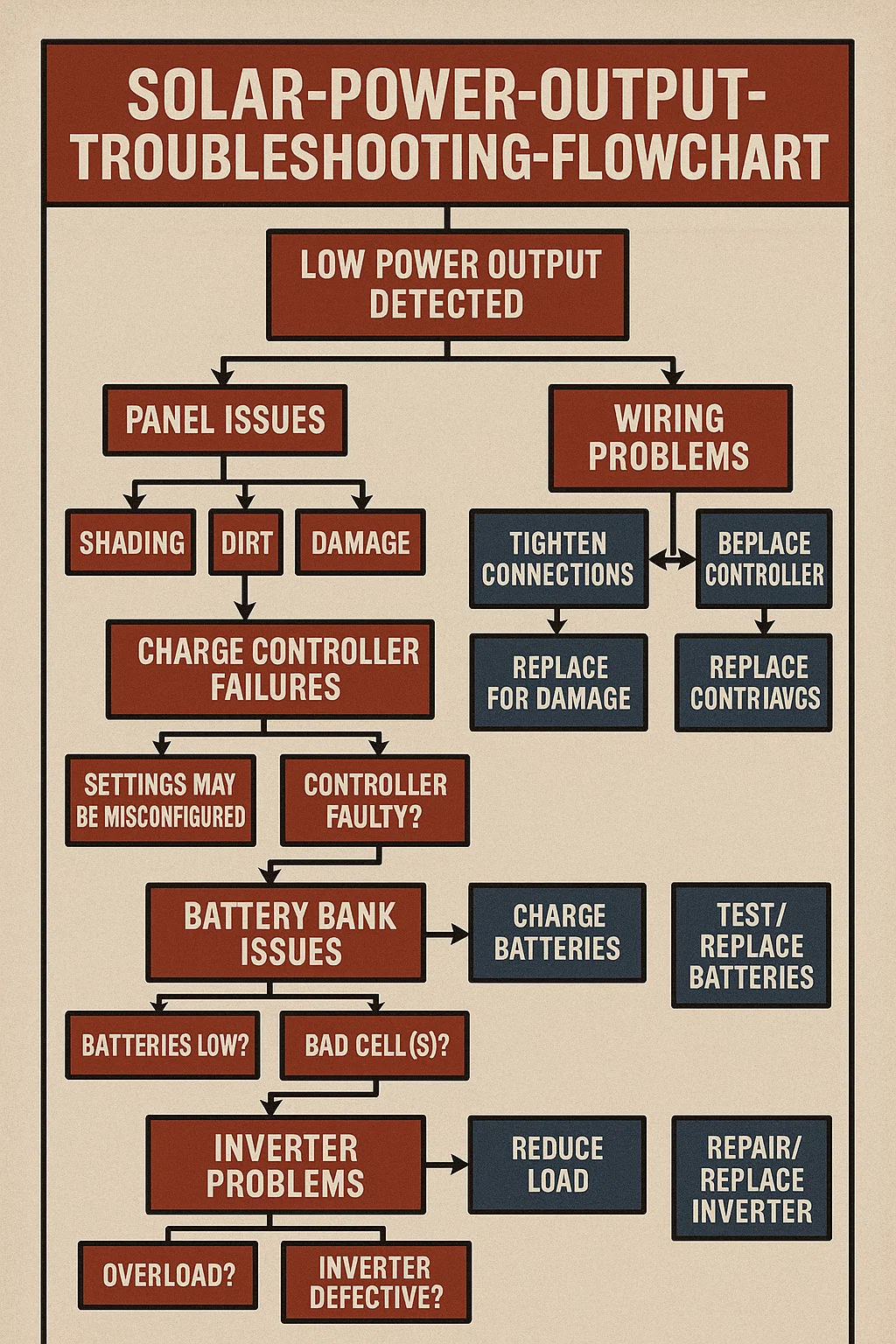
Here's what they don't tell you when selling solar: Every system has five failure modes. Panel problems. Wiring issues. Controller failures. Battery degradation. Environmental factors.
Most are fixable. If you know what to look for when you need to fix low solar output.
Physical damage creates hot spots. Micro-cracks spread from impacts you don't remember. Delamination from moisture lets water short internal connections. Shading that wasn't there last year blocks production.
According to the National Renewable Energy Laboratory, most solar panel failures come from moisture penetration and junction box issues rather than cell degradation.
This is where most systems die. MC4 connectors corrode from moisture penetration. Terminal connections loosen from thermal cycling. Wire insulation cracks in UV exposure and temperature swings. Fuses degrade, increase resistance, create voltage drops.
One bad connection can kill an entire string. If you need to fix low solar output, start with connections. They fail more than panels.
Controllers throttle when they overheat. Poor ventilation during heavy loads drops output capacity. Settings get corrupted or changed accidentally. Component aging reduces efficiency gradually.
The Department of Energy notes that proper ventilation and temperature management are critical for maintaining MPPT controller efficiency.
Panels: Damage, shading, dirt, degradation, orientation
Wiring: Loose connections, corrosion, damaged cables, bad fuses
Controllers: Overheating, settings, firmware, component failure
Batteries: Cell failure, BMS issues, capacity loss, temperature effects
Environmental: Unexpected shading, extreme temperatures, reflectivity changes
My grandfather was an electrician. He taught me: electricity flows like water. Find leaks by following the flow. Measure at each junction. When values don't match expectations, you found the problem.
Forget expensive diagnostic equipment. To fix low solar output, you need five things:
Total cost: under $200. Compare that to a service call. If you can even get one.
Solar arrays generate deadly voltage even in low light. Always disconnect breakers before handling connections. Batteries deliver lethal current instantly. Use insulated tools. Remove metal jewelry. Review our DIY installation safety protocols before working on electrical components.
Start with the obvious. Three of my sixteen panels were snow-covered. That explained some loss. But not the severe drop I was seeing.
Look for cracks. Even small ones matter. Check for discoloration—yellowing means UV degradation. Moisture under glass indicates seal failure. Burn marks suggest electrical problems.
I found a small crack. Moisture penetration. Discoloration on another panel. Issues. But not the main problem.
Disconnect at the combiner box. Test each string's open circuit voltage.
String #2 showed 162V instead of 240V. Found it.
Isolate individual panels in that string. Panel #8: 21V instead of 40V. Panel #9: 14V instead of 40V. Either severe internal damage or connection failure.
Between panels #8 and #9: loose MC4 connector. Visible corrosion on metal contacts. Tiny gap allowed moisture in. Created galvanic corrosion. Resistance skyrocketed. Power flow dropped to nothing.
One bad connector effectively killed four panels in series.
MC4 connectors aren't waterproof in all conditions. Installers sometimes don't click them fully. Temperature cycling creates micro-gaps. Water gets in. Electrolysis starts. Corrosion builds. Resistance increases gradually until the connection effectively opens.
Your panels are fine. Your wiring killed them. That's why when you need to fix low solar output, always check connections first.
Every MC4 connection between panels. Combiner box terminals and fuses. Controller input connections. Battery terminals and cables. Hot spots with infrared thermometer reveal bad connections before they fail completely.
I had the diagnosis. Now I needed to fix low solar output. Fast.
Spare MC4 connector from my emergency kit. Cut out the corroded section. Strip wires. Install new connector. Four panels back online. 1,500 watts restored. Ten-minute fix. If you have the parts.
Removed enclosure cover. Positioned battery-powered fan for airflow. Not permanent. But allowed full capacity operation. Controller stopped throttling immediately.
Removed snow. Cleaned dust and light dirt. Small improvement across entire array. Every watt matters when you're running on fumes.
System output jumped from 2,500W to 5,700W.
Not quite the rated 6,240W. But more than double the failing output. Batteries started charging again. Heat came back online. Crisis averted.
Prevent 90% of battery failures with this professional maintenance checklist. Print-friendly format covers daily checks, monthly maintenance, and early warning signs. Used by 5,000+ off-grid patriots.
Get Your Free ChecklistThat crisis changed everything. I went from passive consumer to active operator. Systems don't maintain themselves.
Daily: Performance metrics check against expected values
Weekly: Visual inspection of panels, connections, controller
Monthly: Clean panels, check all connections, verify settings
Quarterly: Full diagnostic with voltage/current measurements
Annually: Comprehensive inspection, baseline updates, preventative replacements
See our complete Maintenance & Troubleshooting Guide for detailed inspection checklists.

I learned to fix low solar output the expensive way. Paid a contractor $15,000 for a system that failed in the first winter. He never came back to fix it.
Spent the next year learning to diagnose and repair everything myself. Built proper documentation. Created maintenance protocols.
The grid doesn't care if you freeze. Your equipment doesn't care if it's convenient. The only person responsible for your power is you. Master your system or it will master you.
Clear snow and ice from panels first. Test open circuit voltage on each string. Check for frozen moisture in MC4 connectors—this is the most common winter failure. Improve charge controller ventilation if throttling. Monitor battery voltage under load.
Five main causes: corroded MC4 connectors (most common), overheating charge controllers, damaged panels, loose wiring connections, and battery issues that appear as production problems. Systematic voltage testing reveals which component is failing.
Yes. Most off-grid owners successfully fix low solar output themselves. A multimeter, wire brush, spare MC4 connectors, and basic tools handle 90% of problems. Call professionals only for inverter internal failures or if uncomfortable with 200-600V DC panel voltage.
Essential tools: digital multimeter for voltage/current, infrared thermometer for hot spots, basic hand tools, wire brush and contact cleaner, insulated gloves, spare MC4 connectors and fuses. Total cost under $200.
Corroded MC4 connectors between panels. Moisture penetration creates galvanic corrosion, increasing resistance and killing output from entire panel strings. Second most common: charge controller thermal throttling from poor ventilation.
Calculate exactly what you need. Avoid undersizing that causes low output. Avoid oversizing that wastes money. Get the right system for your situation.
Calculate Your System SizeThe corporate energy structure wants dependent consumers. They want you calling experts. Paying service fees. Waiting for help.
True independence requires knowing how to fix low solar output yourself. It demands understanding your system intimately. Maintaining it diligently. Possessing the knowledge to troubleshoot when output drops.
My system runs at peak efficiency now. When performance drops, I identify and fix low solar output within hours. Usually before it impacts daily life. That's not luck. It's deliberate learning and systematic maintenance.
Master your system. Or it will master you. Usually at the worst possible moment.
This guide on how to fix low solar output is part of our comprehensive Off-Grid Solar Maintenance & Troubleshooting Pillar.
Related guides:
© OffGridPowerHub.com | Helping 5,000+ patriots achieve energy independence