
Energy Independence
for American Patriots
for American Patriots
TARIFF ALERT: Solar prices rising 25-40% in 2025 - Secure American-made independence NOW
This food storage methods guide compares every option by real cost and actual shelf life. Not marketing claims. Not best-case scenarios. What works in your home, with your budget, for your family's security.
Best overall method: Mylar bags + oxygen absorbers. $0.50-1.00 per pound. 25+ year shelf life for dry goods.
Best for complete meals: Commercial freeze-dried food. 25-year shelf life. No DIY required.
Biggest mistake: Storing food in garages or uncontrolled spaces. Temperature swings cut shelf life by 50% for every 10°F increase.
Bottom line: Combine methods based on food type. Mylar for staples. Freeze-dried for variety. Canning for garden produce. Budget: $1,600-2,600 per person for one year.
You remember the feeling. Walking through a grocery store with gaps where food should be. Wondering how long until your family felt it. Promising yourself you'd never be caught unprepared again. That promise requires action. The right food storage methods turn anxiety into security.
Twenty-five pounds of rice. Fifteen pounds of beans. Cases of canned goods. All sitting on my living room floor.
Months of food security. Zero storage space.
The garage? Temperature swings from 40°F to 110°F. That's food destruction, not food storage.
Spare closet? Already full of things that don't keep my family fed.
That day taught me something about food storage methods. Buying food is the easy part. Storing it properly is where most people fail.
American homes weren't designed for food storage. Your grandparents had root cellars and pantries the size of bathrooms. You got particle board cabinets and a refrigerator that holds a week of groceries.
The system built dependency into every blueprint. This guide shows you how to fight back.
Before diving into each method, here's how they compare on the metrics that matter: cost, shelf life, and difficulty.
| Method | Shelf Life | Cost Per Lb | Initial Cost | Best For |
|---|---|---|---|---|
| Mylar + O2 Absorbers | 25+ years | $0.50-1.00 | $50-100 | Dry goods, grains, beans |
| Food-Grade Buckets | 25+ years* | $0.40-0.60 | $15-25 each | Bulk staples, rodent protection |
| Freeze-Dried (Commercial) | 25+ years | $15-25 | $0 | Complete meals, variety |
| Freeze-Dried (DIY) | 25+ years | $2-4 | $2,500-4,000 | Garden produce, custom meals |
| Vacuum Sealing | 1-5 years | $0.25-0.50 | $100-300 | Nuts, coffee, shorter-term |
| Canning | 1-5 years | $0.75-1.50 | $100-300 | Garden produce, meats, soups |
| Root Cellar/Cool Storage | 3-8 months | $0.10-0.30 | $50-500 | Root vegetables, squash, apples |
*With mylar bag liners inside buckets
Every food storage method fights the same four enemies. Understanding them helps you choose the right method for each food type.
Every 10°F increase cuts shelf life in half. This isn't marketing. It's chemistry.
Food stored at 70°F lasts twice as long as food stored at 80°F. Food at 60°F lasts four times longer than food at 80°F.
Your garage hitting 100°F in summer? You're not storing food. You're composting it slowly.
Oxygen causes oxidation. Oils go rancid. Colors fade. Nutrients degrade. Bacteria thrive.
Oxygen absorbers and vacuum sealing exist to fight this enemy. Neither works if your seal fails.
Humidity above 60% brings mold, bacterial growth, and packaging failure. Basements are particularly dangerous without dehumidification.
Dry goods absorb moisture from air. What went in at 10% moisture can reach 15% and start growing things.
One mouse produces 60 offspring per year. One pair of weevils produces 6,000 in one season. Your home isn't sealed as well as you think.
Cardboard boxes and plastic bags are pest invitations. Mylar bags and sealed buckets are pest barriers.
Lost $2,400 in rice and beans my first year of food storage. Kept it in the garage because "that's where preppers store food." Summer hit 105°F for two weeks. Everything went rancid or developed off-flavors. Learned the hard way that temperature control matters more than the container. Now everything lives in climate-controlled space. Even if that means reorganizing closets.
Gold standard for dry goods. Lowest cost per pound. Longest proven shelf life.
5-mil mylar bags create oxygen and moisture barriers. Oxygen absorbers remove remaining oxygen after sealing. Heat sealing with a household iron creates an airtight closure.
For complete mylar bag and oxygen absorber kits, food preservation bags from Amazon provide everything needed to start.
Doesn't work for high-fat foods (nuts, oils). Not suitable for foods with more than 10% moisture content. Requires proper sealing technique.
Rodent-proof. Stackable. Works with or without mylar liners.
Standard lid: Requires lid opener tool. Creates tight seal. $8-12 per bucket with lid.
Gamma seal lid: Screw-on access without tools. Better for foods you access regularly. $8-10 additional per lid.
For stackable, rodent-proof storage, gamma seal lid food storage buckets provide easy access to supplies.
Use mylar bags inside buckets for maximum protection. Bucket provides physical barrier against rodents and light. Mylar provides oxygen and moisture barrier. Combined approach offers best results.
Access our complete food storage planning resources. Calculate exactly how much you need. Avoid costly mistakes.
Access Food Storage Guide✅ Trusted by preppers who plan, not panic-buy
Removes 98% water. Preserves 97% nutrition. Works for almost any food including complete meals.
Pre-packaged meals require no preparation beyond adding water. Variety includes breakfast, lunch, dinner, and desserts. Nutrition labels accurate. Shelf life guaranteed.
My Patriot Supply freeze-dried food offers 25-year shelf life with variety packs for balanced nutrition.
Break-even point: 600-800 lbs of preserved food compared to buying commercial.
Best for: Families with large gardens, those wanting custom meal control, or anyone preserving expensive proteins like beef and eggs.
For home freeze drying, freeze dryer machines with 5 trays handle 7-10 lbs per batch.
Removes air for medium-term storage. Best for items you rotate regularly.
Advantage: 75% bulk reduction. Excellent for pantry organization and freezer storage extension.
Limitation: Not suitable for 20+ year storage. Requires ongoing bag costs. Some foods crush during sealing.
The FoodSaver vacuum sealer handles most home food storage needs reliably.
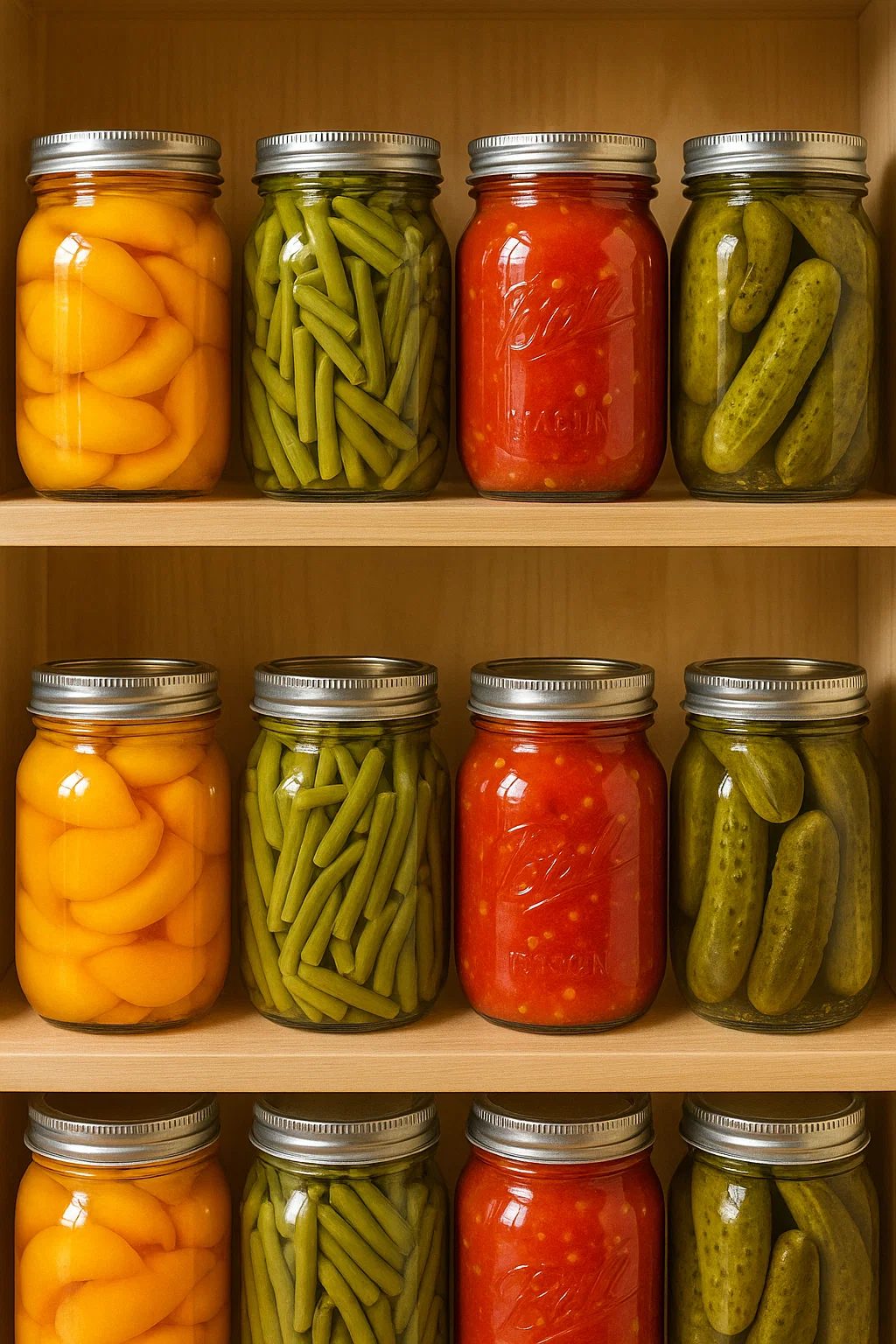
Traditional preservation method proven for 200+ years. Best for garden produce and homemade meals.
Water bath canning: For high-acid foods only. Tomatoes, fruits, jams, pickles, salsas. Simpler equipment and process.
Pressure canning: Required for low-acid foods. Vegetables, meats, soups, stocks, beans. Requires pressure canner and careful technique.
Reality check: Canning is labor-intensive. One batch takes 2-4 hours. Shorter shelf life than mylar or freeze-dried. But it works for foods those methods can't preserve.
For safe home canning, complete canning kits include everything needed to start. The All American Pressure Canner is the gold standard for low-acid foods.
For proper technique, food preservation books provide USDA-approved recipes and safety guidelines.
Traditional root cellars aren't feasible for most. Here's what works in modern homes.
Buried cooler: Dig hole in coolest yard spot. Bury insulated cooler with drainage holes. Maintains 45-55°F year-round. Perfect for root vegetables, squash, apples.
Dead chest freezer: Non-running freezer equals insulated storage. Place in basement or cool garage. Stable temperature without power draw.
Basement corner: Insulate one corner from rest of basement. Add ventilation pipe to outside. Creates natural cool zone for fresh storage.
Professional freeze-dried meals with guaranteed 25-year shelf life. Complete nutrition. Just add water.
View Emergency Food Options✅ Ready when you need it. Lasts until you don't.
Your home has more storage than you see. Finding it is a food storage method unto itself.
American families waste $1,500+ annually on spoiled food. Building food storage? That number can explode.
Temperature swings from 40°F to 110°F destroy food faster than you'd believe. One hot summer can ruin years of preparation. Always use climate-controlled interior space.
Mylar bags without oxygen absorbers provide only partial protection. Oxygen remaining inside continues degradation. The $20 you save costs $200 in spoiled food.
Nuts, cooking oils, and brown rice go rancid regardless of container. Plan to rotate these every 6-12 months. Don't store them for 25 years.
Dry goods must be under 10% moisture before sealing. Higher moisture content causes bacterial growth inside sealed containers. Some foods need additional drying before storage.
Food you can't find is food you can't use. Rotation fails when you forget what's stored where. Simple spreadsheet or labeling system prevents waste.
Don't pick one food storage method. Combine them based on food type. Mylar bags for staples like rice and beans. Freeze-dried for complete meals and variety. Canning for garden overflow. Cool storage for fresh produce rotation. Each method has strengths. Smart preppers use all of them where they make sense.

Your suburban home wasn't designed for food independence. Transform it anyway.
Combine food storage methods based on what you're storing. Mylar for bulk staples. Freeze-dried for variety and complete meals. Canning for garden abundance. Cool storage for fresh produce rotation.
When panic-buyers face empty shelves, you'll rotate stock. When supply chains shatter, you'll operate from calm. When grids fail and refrigerators die, you'll access shelf-stable supplies.
Your ancestors survived winters and droughts with less technology. You have better tools. Use them.
Hope isn't a strategy. Neither is assuming the grocery store will always have what you need. The families who thrive through disruption are the ones who prepared before they had to. You're reading this because something inside you knows better. Trust that instinct. Start with one food storage method. Add more as budget allows. Progress beats perfection.
Climate, humidity, and local conditions affect food storage methods. Our GPT assistant provides guidance based on your zip code.
Access OffGridPowerHub GPTEvery week you wait is another week of vulnerability. Begin with one food storage method. Add more as you learn. The goal isn't perfection. It's progress toward a family that doesn't depend on systems outside your control.
Start With Emergency Food Supply