 TARIFF ALERT: Solar prices rising 25-40% in 2025 - Secure American-made independence NOW
for American Patriots
Off Grid Solar Basics: 4 Things to Know Before You Spend a Dime
Solar feels complicated. It does not have to be. Here are the basics that matter, explained like a neighbor would.
Built for the dad drowning in YouTube videos who just wants a straight answer.
Last Updated: February 2026 | US Solar Institute Trained | 13+ Years Off-Grid
Quick Answer: Off Grid Solar Basics
Off grid solar basics come down to 4 components: panels, charge controller, batteries, and inverter. That is the entire system. Everything else is detail.
Before you buy anything, answer 3 questions. How much power do you use daily? How many peak sun hours does your location get?
What is your budget? Answer those first. Everything else follows.
The biggest beginner mistake: Buying components before understanding how they work together. A mismatched system wastes thousands.
Free Off Grid Solar System Calculator
Answer a few questions. Get your custom system size. Takes 60 seconds. No sales pitch.
Use the Free CalculatorWhat This Guide Covers
Off Grid Solar Basics: The Overwhelm Is Normal
Off grid solar basics should be simple. Four components. One goal. But the internet makes it feel impossible.
You search "off grid solar." You get 47 million results. Half contradict each other.
One video says 12V. The next says 48V or your house burns down. Forums argue about battery chemistry like religion.
You are not stupid. The information is badly organized. That is the real problem.
Here Is What Happened to Me
I spent $15,000 on a contractor who installed the wrong system. 12V for a full house. Batteries melted. Toxic fumes in the garage.
Had to evacuate during a hurricane. $15,000 of useless panels on the roof.
That disaster sent me to the US Solar Institute. Got trained. Rebuilt everything myself. Zero electric bills since 2012.
The lesson: understanding the basics saves thousands. You do not need an engineering degree. You need the right foundation.
Have you ever closed 15 browser tabs and felt more confused than when you started?
Off Grid Solar Basics: The 4 Parts of Every System
Every off grid solar system on earth uses these same 4 components. A cabin. An RV. A full house. Same four parts.
The size changes. The function does not.
1. Solar Panels
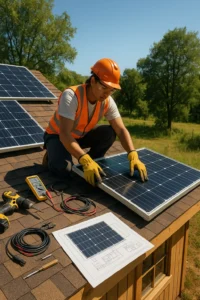
Convert sunlight into electricity (DC power). Monocrystalline panels are the standard for efficiency and lifespan. Typical home systems use 15-30 panels.
They produce power only when the sun shines. Everything else in the system exists because panels cannot work at night.
2. Charge Controller
Sits between your panels and batteries. Regulates voltage and current so your batteries charge safely. Without it, panels would overcharge and destroy your battery bank.
MPPT controllers are 20-30% more efficient than PWM. Worth the extra cost on any system over 200 watts.
3. Battery Bank
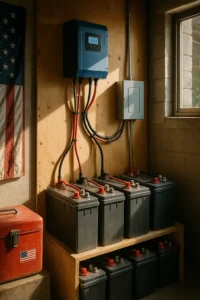
Stores energy for nights, cloudy days, and emergencies. This is the most critical and expensive component.
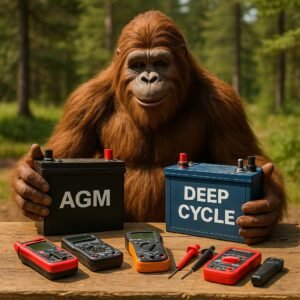
LiFePO4 batteries last 6,000+ cycles. Lead-acid lasts 300-800 cycles. The math is clear. Our tested battery picks are what we run on our own property.
4. Inverter
Converts stored DC battery power into AC power. That is what your appliances use. Pure sine wave inverters run everything cleanly.
Modified sine wave damages sensitive electronics over time. Size your inverter for peak load, not average load. Our Inverter Buying Guide explains the difference.
That is it. Off grid solar basics in four parts. Panels make power. Controller protects batteries.
Batteries store power. Inverter delivers power. Everything else is sizing and matching.
Wattson's Wisdom
Think of it like plumbing. Panels are the well. Controller is the pressure regulator. Batteries are the tank. Inverter is the faucet.
Miss one piece and nothing works. Match them wrong and something breaks.
Not Sure What Size System You Need?
Our free calculator figures it out in 60 seconds. Enter your daily usage and location. Get your answer.
Use the Free CalculatorOff Grid Solar Basics: 3 Questions Before You Buy
Do not buy a single panel until you can answer these three questions.
Every dollar wasted on off grid solar basics comes from skipping one of them.
Question 1: How Much Power Do You Actually Use?
Pull your electric bill. Find the kWh number. Divide by 30. That is your daily average.
A typical American home uses 30 kWh per day. A cabin might use 3-5 kWh. An RV uses 1-3 kWh. Your number determines everything.
Our Load Assessment Guide walks through this step by step.
Question 2: How Many Peak Sun Hours Does Your Location Get?
Peak sun hours determine how much your panels produce. Arizona gets 6-7 hours. Oregon gets 3-4. Same panels, half the output.
The U.S. Department of Energy publishes solar resource data by ZIP code.
Question 3: What Is Your Budget?
Be honest. A small cabin system starts at $5,000-$8,000. A full home runs $25,000-$40,000. The federal tax credit cuts 30% off that.
The National Renewable Energy Laboratory tracks current pricing.
Quality components cost more upfront but last 15-25 years. Budget components fail in 2-3 years. Cost more to replace than to do it right.
If you cannot answer all three questions right now, that is exactly why this guide exists. Start with question one.
Off Grid Solar Basics: The Mistakes That Cost Beginners Thousands
Every expensive solar disaster I have seen comes from ignoring off grid solar basics. These five mistakes are all preventable.
Buying Components Before Understanding the System
Panels on sale are not a deal if they do not match your charge controller. Components must work as a system.
Buy the plan first. Parts second.
Trusting a Contractor Who Cannot Explain the Basics
If your installer cannot explain why 48V beats 12V for a house, walk away. My $15,000 lesson proved that.
Credentials on a business card do not equal competence. Even if you hire someone, know enough to verify the numbers.
Sizing for Today Instead of Tomorrow
Your family's needs will grow. EV charger. Workshop tools. Second freezer.
Adding capacity later costs 2-3 times more. Our System Sizing Guide covers this in detail.
Choosing 12V Architecture for a Full House
12V systems draw massive current for household loads. Wires overheat. Batteries strain. Voltage drops kill efficiency.
48V is the standard for any system powering a full home. No exceptions.
Skipping the Battery Math
Your battery bank must store enough for 3 days without sun. Undersized batteries overwork daily. They die in 2-3 years.
A $10,000 bank replaced twice costs more than sizing it right once.
Wattson's Wisdom
The cheapest solar system is the one you build right the first time. Every shortcut adds cost later.
I rebuilt my entire system from scratch after cutting corners. Do not be 2012 me.
Your Next Step With Off Grid Solar Basics
You now understand off grid solar basics better than 90% of people who start shopping. Not an exaggeration.
Most people buy before they understand. You are already ahead.
Here is your path forward:
Step 1: Know Your Numbers
Use our free solar calculator to find your daily kWh, peak sun hours, and recommended system size. Takes 60 seconds.
Step 2: Learn the Components
Read our Beginner's Guide to Off-Grid Solar Power (Pillar 1 hub). It covers every component, every decision, every trade-off.
Step 3: Ask Location-Specific Questions
Our OffGridPowerHub GPT tool gives permit requirements, peak sun hours, and sizing guidance for your ZIP code.
We only recommend products we personally use. If you are shopping for panels, check our tested picks for solar panels on Amazon.
Disclosure: Some links are affiliate links. We earn a small commission at no extra cost to you. We only recommend products we use on our own property.
Frequently Asked Questions
Continue Learning Off Grid Solar Basics
Now that you have the off grid solar basics down, these guides go deeper on each topic from our Beginner's Guide (Pillar 1):
What Is Off-Grid Solar Power?
Complete breakdown of how off-grid solar works. No jargon. Plain English.
Grid-Tied vs Off-Grid vs Hybrid
Which system type fits your situation? Compare all three side by side.
Is Off-Grid Solar Worth It?
Real cost analysis with actual numbers. No sales pitch. Just math.
Ready to Stop Guessing?
You have the off grid solar basics. Get your custom system size in 60 seconds.
No confusion. No overselling. Just the right answer for your family.
Get the Free Solar Buyer's Checklist