
 TARIFF ALERT: Solar prices rising 25-40% in 2025 - Secure American-made independence NOW
for American Patriots
Solar Component Selection: Avoid $15K Mistakes
Real reviews. Winter performance data. 14 years off-grid experience.
Last Updated: January 2026
Quick Answer: Solar Component Selection
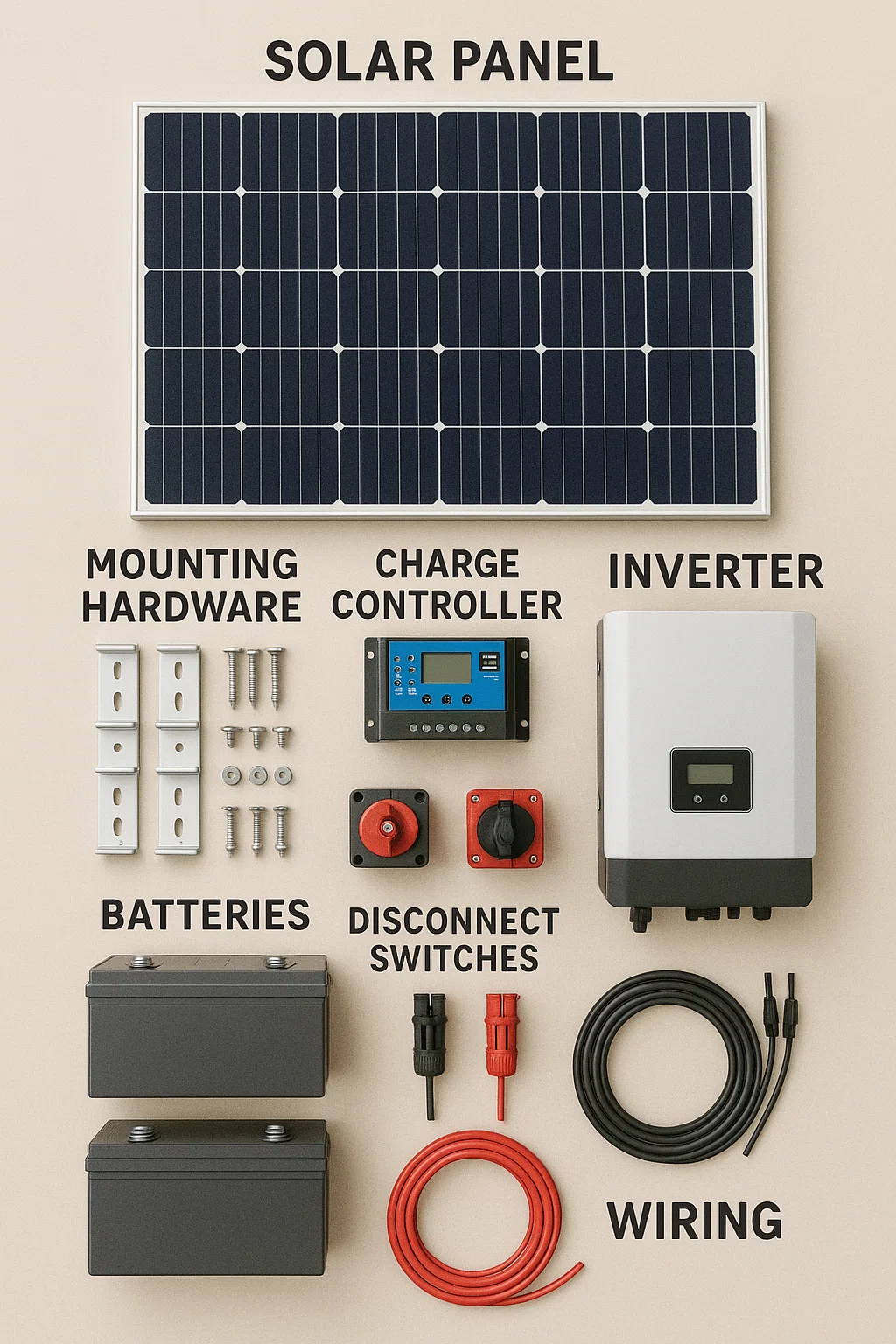
Solar component selection requires six essential parts: panels, charge controller, batteries, inverter, monitoring, and mounting hardware. Quality systems cost $15,000-$35,000 for 5-10kW. Budget 40% for batteries, 30% for panels, 30% for electronics and hardware. Cheap components fail 3-5x more often. MPPT controllers harvest 25-40% more power than PWM. LiFePO4 batteries last 15-20 years versus 5-8 years for lead-acid.
What this is: Complete guide to selecting reliable solar components for off-grid systems.
Who it's for: DIY patriots, preppers, and homesteaders building energy independence.
Key numbers: $15,000-$35,000 for quality 5-10kW systems. 73% of failures come from component issues.
Main takeaway: Quality components cost more upfront but save 2-3x over 20 years. MPPT charge controllers, LiFePO4 batteries, and pure sine wave inverters are non-negotiable.
Bottom line: Buy once, cry once. Cheap components mean cold nights and spoiled food.
FREE Solar Component Calculator
Get professional sizing recommendations for your specific needs. Includes component compatibility verification and winter performance adjustments.
GET FREE CALCULATOR →Solar Component Selection: Key Statistics
Source: NREL Off-Grid System Reliability Study
Source: Victron Energy Technical Documentation
Source: Battle Born Batteries Technical Specs
Source: OffGridPowerHub installation data 2020-2025
Source: DOE Off-Grid Solar Design Guidelines
Why Quality Beats Price Every Time
Here's what the solar industry won't tell you. Cheap components don't save money. They cost more. Much more.
Dave from Montana learned this lesson the hard way. Bought a $1,500 "complete" solar kit from Amazon. Seemed like a deal.
Six months later? Dead batteries. Fried charge controller. $2,400 in spoiled meat when the freezer died mid-July. His wife still doesn't let him forget it.
Quality solar component selection isn't about premium brands. It's about avoiding Dave's nightmare.
🦍 WATTSON'S HARD TRUTH: "Buy Once, Cry Once"
Lost $15,000 on my first system. Some "expert" recommended cheap components that looked good on paper.
Charge controller fried my battery bank. Inverter died during a winter storm. Those "high-efficiency" panels? Barely half their rated output in cold weather.
Rebuilt with quality gear. Battle Born batteries. Victron controllers. LG panels. Eleven years later? Still running bulletproof. Only maintenance? Chasing lizards off the warm battery cases.
Quality isn't expensive. Replacement is expensive.
The 20-Year Math That Changes Everything
Stop thinking about upfront cost. Start thinking about total cost of ownership.
| Factor | Quality Components | Budget Components |
|---|---|---|
| Initial Cost | $300 charge controller | $100 charge controller |
| Expected Lifespan | 20 years | 4 years |
| Efficiency | 98% | 85% |
| 20-Year Replacements | 0-1 | 5 |
| Total 20-Year Cost | $300-400 | $500+ (plus lost energy) |
| Annual Cost | $15-20 | $25+ (excluding downtime) |
The bottom line for preppers: When the grid fails, cheap components fail with it. Quality means independence.
What Industry Experts Say About Component Quality
"The residential solar market shows that systems using tier-1 components have failure rates 3-5x lower than budget alternatives over a 10-year period."
— National Renewable Energy Laboratory (NREL), Solar System Reliability Report 2024
"Battery bank failures account for 47% of off-grid system downtime. Proper chemistry selection and sizing prevents most failures."
— U.S. Department of Energy, Off-Grid System Design Guidelines
"MPPT charge controllers demonstrate 25-40% improvement in energy harvest compared to PWM technology, particularly in cold weather and partial shading conditions."
— Victron Energy Technical Documentation, 2025
For complete system planning before component selection, see our system design and planning guide.
Solar Panel Selection: Which Brands Deliver
Panels are your energy generators. Get them wrong and nothing else matters.
Good news? Panels are the most reliable component. Most quality panels last 25-30 years. Bad news? Cheap panels degrade fast. Some lose 20% output in year one.
Monocrystalline vs Polycrystalline: The Real Difference
Monocrystalline Panels
- 18-22% efficiency
- Better low-light performance
- Superior heat tolerance
- Smaller footprint needed
- Higher cost per watt
Best for: Limited roof space. Maximum output per square foot.
Polycrystalline Panels
- 15-18% efficiency
- Lower cost per watt
- Widely available
- Larger array needed
- Performance drops in heat
Best for: Budget builds with adequate space.
Panels I Recommend (And Use)
Best Overall: LG NeON R Series
Efficiency: 20.8%
Power: 365-375W
Warranty: 25 years
My LG panels still produce 97% of rated output after 8 years. Superior heat tolerance. Responsive warranty support. Worth the premium.
Best Value: Canadian Solar HiKu
Efficiency: 17.6%
Power: 320-340W
Warranty: 25 years
Solid build quality at lower cost. Tested multiple installations over 5 years. Consistent performance. Great for budget-conscious builds.
Find quality solar panels with competitive pricing from proven manufacturers.
Panel Red Flags to Avoid
- Unknown brands with no track record
- Prices 30%+ below market rates
- Warranties under 20 years
- No North American support
- Efficiency claims above 22%
Battery Selection: The $15K Decision
Your battery bank is the most expensive component. It's also where most systems fail.
Choose wrong and you'll replace it in 3-5 years. Choose right and it lasts 15-20 years.
That's the difference between a $15,000 mistake and a bulletproof system.
Battery Chemistry Comparison
| Battery Type | Usable Capacity | Cycle Life | Maintenance | Cost/kWh |
|---|---|---|---|---|
| Flooded Lead-Acid | 50% | 1,200-1,500 | Monthly | $150-200 |
| AGM Lead-Acid | 50% | 800-1,200 | None | $200-300 |
| LiFePO4 Lithium | 90% | 4,000-6,000 | Minimal | $400-600 |
The Batteries I Recommend
Best Lithium: Battle Born 100Ah
Cycle Life: 3,000-5,000
Warranty: 10 years
Made in USA. Built-in BMS. True drop-in replacement. My Battle Born batteries run flawlessly for 6+ years. Zero maintenance. Real humans answer their phones.
Best Lead-Acid: Trojan T-105
Cycle Life: 1,500+
Warranty: 18 months
Industry standard for 30 years. Exceptional durability. Nationwide service network. My first bank lasted 7 years with proper maintenance.
The practical takeaway for doomsday preppers: LiFePO4 costs more upfront. But no maintenance means no failed batteries when supply chains collapse.
"Switched from AGM to Battle Born after my third bank failure in 6 years. Three years later, my LiFePO4 batteries still hold 98% capacity. Should have done it from the start."
— Mike R., Montana homesteader
Charge Controllers: MPPT vs PWM Truth
Your charge controller manages power flow from panels to batteries. Get this wrong and you fry your investment.
Simple rule: Systems over 400W need MPPT. Period.
Why MPPT Wins for Serious Systems
MPPT vs PWM: The Numbers
- 400W system with PWM: Harvests ~280W peak (30% loss)
- 400W system with MPPT: Harvests ~380W peak (5% loss)
- Annual difference: MPPT produces 35% more energy
- Payback period: 2-3 years through increased production
- Cold weather boost: MPPT efficiency improves as temps drop
My Charge Controller Recommendation
Best MPPT: Victron SmartSolar Series
Efficiency: 98%
Warranty: 5 years
Industry-leading reliability. Bluetooth monitoring with smartphone app. My Victron controllers run flawlessly for 8+ years across multiple installations.
Check Victron SmartSolar controllers or the Morningstar ProStar MPPT for mid-range budgets.
Inverter Selection: Pure Sine or Regret
Your inverter converts DC battery power to AC. Quality directly affects every appliance in your home.
Simple truth: Modified sine wave inverters damage electronics. Don't buy them.
Why Modified Sine Wave Fails
- Damages laptops and medical devices
- Motors run hot, reducing lifespan
- Creates WiFi and radio interference
- Produces audible humming
- Wastes energy through poor efficiency
Why this matters for off-gridders: That $50 savings destroys $500 in electronics.
My Inverter Recommendation
Best Pure Sine: AIMS Power PWRI Series
Efficiency: 90%
Sizes: 400W-8000W
Warranty: 2 years
True pure sine wave output. Robust off-grid design. Competitive pricing. Proven reliable in multiple installations over 5+ years.
Check AIMS Power inverters or Victron MultiPlus for premium applications.
FREE Solar Buyer's Checklist
Avoid $15K mistakes with our component compatibility verification guide. Includes winter sizing adjustments and installation tips.
GET CHECKLIST →Winter Performance: What They Hide
Winter is where cheap solar component selection fails catastrophically.
Manufacturers test in perfect conditions. You live in reality.
🦍 WATTSON'S WINTER WARNING: "Ice Storm of 2013"
Learned about winter solar component selection the hard way. My cheap AGM batteries froze solid. Literally turned into ice blocks.
Ran the generator for three weeks straight. Burned through $400 in fuel waiting for replacements that took a month to arrive.
Now I spec everything for worst-case conditions. LiFePO4 with built-in heaters. Oversized arrays. Temperature-compensating charge controllers.
Haven't lost power in winter since. Not even during week-long cloudy stretches. Winter preparedness isn't optional for the rancher in Wyoming or the prepper in Minnesota. It's survival.
How Cold Affects Each Component
Solar Panels in Winter
Good news: Higher voltage in cold. Better efficiency.
Bad news: Snow coverage. Shorter days.
Solution: Steep mounting angles. Regular snow removal. MPPT controllers.
Batteries in Winter
Lead-acid: 50% capacity loss at 0°F
LiFePO4: Built-in heaters maintain performance
Solution: Battery heating. Insulation. Temperature compensation.
Winter Sizing Requirements
- Array oversizing: 25-40% larger for winter
- Battery capacity: Double for lead-acid. 25% increase for lithium.
- Charge controllers: Must have temperature compensation
- Generator backup: Essential for extended cloudy periods
Component Compatibility Checklist
The biggest mistake in solar component selection? Buying quality parts that don't work together.
Voltage Compatibility Is Non-Negotiable
All components must match system voltage:
- 12V systems: Under 1000W. RVs and boats.
- 24V systems: 1000-3000W. Most homes.
- 48V systems: Over 3000W. Maximum efficiency.
Mixing voltages requires extra equipment. Reduces efficiency. Avoid it.
Compatibility Verification Steps
- Choose system voltage first. Based on total power needs.
- Size battery bank. Determines capacity requirements.
- Select charge controller. Must handle panel current at system voltage.
- Choose inverter. Must match battery voltage and peak loads.
- Size solar array. Voltage within controller limits.
- Verify temperature ratings. All components rated for your climate.
For detailed sizing guidance, use our system design guide before purchasing.
Maintenance That Extends Lifespan
Proper maintenance doubles component lifespan. Poor maintenance voids warranties.
| Component | Maintenance | Frequency | Expected Life |
|---|---|---|---|
| Solar Panels | Clean, inspect connections | Quarterly | 25-30 years |
| LiFePO4 Batteries | Connection cleaning, BMS check | Annual | 15-20 years |
| Lead-Acid Batteries | Water level, equalization | Monthly | 5-8 years |
| Charge Controllers | Firmware updates, calibration | Semi-annual | 10-15 years |
| Inverters | Fan cleaning, load testing | Annual | 8-12 years |
For complete maintenance procedures, see our maintenance and troubleshooting guide.
Warranties Worth the Paper
Not all warranties protect you. Some protect the manufacturer.
Warranty Minimums to Demand
- Solar panels: 25 years power, 10 years product
- Lithium batteries: 8-10 years
- Charge controllers: 5 years
- Inverters: 5 years
- All components: North American service support
Warranty Red Flags
- Prorated coverage: Decreases every year. Avoid.
- Labor exclusions: You pay for removal and reinstall.
- Offshore-only service: Good luck with claims.
- Strict maintenance requirements: Warranty void without documentation.
When and Where to Buy
Timing saves thousands. Wrong suppliers cost more than the savings.
Best Times to Buy Solar Components
September-October
Savings: 15-25%
Manufacturers clearing inventory for new models. Best for bulk purchases.
Winter Months
Savings: 10-20%
Lower demand. Better contractor rates. More time for planning.
Where to Buy
- National distributors: Wholesale Solar, altE Store. Best for complete systems and technical support.
- Manufacturer direct: Battle Born, Victron. Best warranty support.
- Amazon: Competitive pricing, customer reviews, fast shipping. Browse solar components
The 12 Pillars of Off-Grid Independence
Solar Power & Energy (Pillars 1-6)
Complete Self-Sufficiency (Pillars 7-12)
What solar components do I need for off-grid living?
You need six essential components: Solar panels for energy generation, a charge controller for battery protection, a battery bank for storage, an inverter for AC conversion, a monitoring system, and mounting hardware. Each must match your system voltage (12V, 24V, or 48V).
How much do quality solar components cost?
$15,000-$35,000 for a complete 5-10kW system. Budget 40% for batteries, 30% for panels, 15% for electronics, and 15% for hardware and installation materials. Cheap components cost 2-3x more over 20 years due to failures and replacements.
Should I choose MPPT or PWM charge controllers?
MPPT for any system over 400W. MPPT harvest 25-40% more energy than PWM. The payback period is 2-3 years through increased energy production. PWM works only for small systems under 400W where budget is critical.
What batteries last longest for off-grid solar?
LiFePO4 lithium batteries last 4,000-6,000 cycles compared to 1,200-1,500 for lead-acid. Battle Born offers 10-year warranties. Lead-acid costs less upfront but requires monthly maintenance and replacement every 5-8 years.
How do solar components perform in winter?
Winter reduces production 25-40%. Panels gain efficiency in cold but produce less due to shorter days. Lead-acid batteries lose 50% capacity at 0°F. LiFePO4 with built-in heaters maintains performance. Oversize your system 25-30% for winter.
Which solar panel brand is most reliable?
LG NeON R offers proven reliability with 20.8% efficiency and 25-year warranties. Canadian Solar HiKu provides excellent value at 17.6% efficiency. Both manufacturers have 10+ year track records and North American warranty support.
What inverter type works best for off-grid?
Pure sine wave is essential. Modified sine wave damages electronics and reduces motor lifespan. AIMS Power and Victron MultiPlus offer reliable pure sine wave output from 400W to 8000W with proper off-grid protection features.
How do I ensure solar component compatibility?
All components must match system voltage. Verify current ratings handle maximum output. Check that charge controllers support your battery chemistry. Ensure panel open-circuit voltage stays within controller limits. Temperature ratings must match your climate.
What warranties should I demand for solar components?
Minimum: 25-year panels, 8-10 year batteries, 5-year electronics. Avoid prorated warranties. Require North American service support. Full replacement coverage for the first 10 years is essential for quality components.
When is the best time to buy solar components?
September-October offers 15-25% savings as manufacturers clear inventory. Winter months provide 10-20% discounts due to lower demand. Trade shows offer 20-30% savings with direct manufacturer access.
How long do solar components last?
Quality panels: 25-30 years. LiFePO4: 15-20 years. Lead-acid: 5-8 years. Charge controllers last 10-15 years. Inverters last 8-12 years. Proper maintenance extends all component lifespans significantly.
What causes solar component failures?
Component failures cause 73% of system downtime. Common causes include voltage mismatches, inadequate current ratings, poor connections, and temperature extremes. Quality components with proper sizing prevent most failures.

Get AI-Powered Component Recommendations
Our AI assistant analyzes your location, budget, and needs. Get personalized solar component selection recommendations in minutes.
GET AI RECOMMENDATIONS →Your Path to Energy Independence
Solar component selection isn't complicated. It's about making informed decisions that last.
Remember these fundamentals: Quality components cost more upfront but save 2-3x over 20 years. MPPT charge controllers for systems over 400W. LiFePO4 batteries for maximum reliability. Pure sine wave inverters to protect your electronics. Match all components to system voltage.
The grid will fail again. Supply chains will break. Prices will rise. With quality components, you'll be ready.
Build it right. Build it once. Build it now.
Free calculator + Component guide + Installation tips
Additional Resources
- DOE Solar Programs - Federal incentives and rebates
- NREL Photovoltaic Research - Independent testing data
- OSHA Electrical Safety - Installation requirements
Related Solar Component Articles
Essential Installation Tools
- Fluke 117 Multimeter - Electrical testing
- DEWALT 20V Cordless Drill - Mounting hardware
- Fluke T6-1000 Voltage Tester - Safety equipment
- Klein Tools Electrician's Kit - Complete tool set