 TARIFF ALERT: Solar prices rising 25-40% in 2025 - Secure American-made independence NOW
for American Patriots
Solar Load Calculator: 6 Easy Steps to Perfect System Sizing
Trusted by cabin owners and RV DIYers who refuse to guess at battery sizing

Mike bought a 400Ah battery bank for his cabin. Thought it was plenty.
Three days in. Dead batteries at 2am. Fridge warming up. Wife not happy.
Turns out he never ran a solar load calculator. Just guessed. Guessed wrong.
A $200 math problem cost him $1,400 in new batteries.
This solar load calculator guide shows you exactly how much power your system needs. No guessing. No expensive surprises.
A proper solar load calculator prevents undersized systems.
Prevents dead batteries at 2am. Prevents angry spouses.
- Step 1: Find wattage on appliance labels (or calculate Volts × Amps)
- Step 2: Estimate hours per day each appliance runs
- Step 3: Multiply Watts × Hours = Watt-hours per day
- Step 4: Add all watt-hours together for daily total
- Step 5: Add 30% buffer for real-world conditions
- Step 6: Use a Kill-A-Watt meter for tricky appliances
- Result: Your daily kWh tells you battery bank size needed
Why a Solar Load Calculator Matters
Every off-grid system starts with one question. How much power do you actually need?
Get it wrong and you're either broke or in the dark.
Oversized systems waste thousands. Undersized systems fail when you need them most.
A solar load calculator removes the guesswork. Gives you real numbers.
Lets you size batteries, panels, and inverters correctly.
Before you buy anything, run the numbers. Your wallet will thank you.
I've seen folks drop $5,000 on solar gear without knowing their load.
Then they wonder why the batteries die every night.
Thirty minutes with a solar load calculator saves thousands in mistakes.
Do the math first. Buy second.
Step 1: Check the Appliance Label
Every appliance has a label. Usually on the back, side, or inside door.
Look for Watts (W). That's your number. Write it down.
If the label only shows Volts and Amps, no problem. Use this formula:
Example: 120 Volts × 5 Amps = 600 Watts
That's it. No engineering degree required.
Check every appliance you plan to power. Fridge. Lights. TV. Laptop. Coffee maker.
Your solar load calculator is only as good as your input data.
Step 2: Estimate Daily Runtime
Now figure out how long each appliance runs daily.
Be honest. Ballpark estimates work fine.
Typical runtimes:
- Refrigerator: 8-10 hours (cycles on and off)
- TV: 3-4 hours
- Lights: 4-6 hours
- Laptop: 4-5 hours
- Coffee maker: 0.5 hours
Round up slightly. Better to overestimate than run short.
Step 3: Calculate Watt-Hours
This gives you watt-hours per day for each appliance.
Example: 600W fridge × 8 hours = 4,800 Wh/day
Do this for every appliance on your list.
This is the core of your solar load calculator. Each appliance gets a daily energy number.
Want the Math Done For You?
Our Solar Estimator runs these solar load calculator numbers automatically.
Enter your appliances. Get your system size.
Get the Free Solar EstimatorStep 4: Add It All Up
Add every appliance's watt-hours together.
This total is your daily energy consumption.
Divide by 1,000 to convert to kilowatt-hours (kWh).
This number drives everything. Battery bank size. Solar panel array. Inverter capacity.
Your solar load calculator output determines your entire system design.
Step 5: Add Your Buffer
Whatever number you calculated, add 30% minimum.
Why? Because chaos happens.
Your fridge runs longer in summer heat. Cloudy days reduce solar input.
Uncle Bob shows up with a chainsaw. Drains your batteries before lunch.
The 30% buffer keeps you running when reality hits.
Plan for war, not a picnic. Your solar load calculator should assume worst-case scenarios.
Every off-gridder who skipped the buffer regrets it.
First cloudy week. First heat wave. First time company shows up unannounced.
That 30% buffer is the difference between comfort and crisis.
Learn more about battery sizing in our Battery Storage Guide.
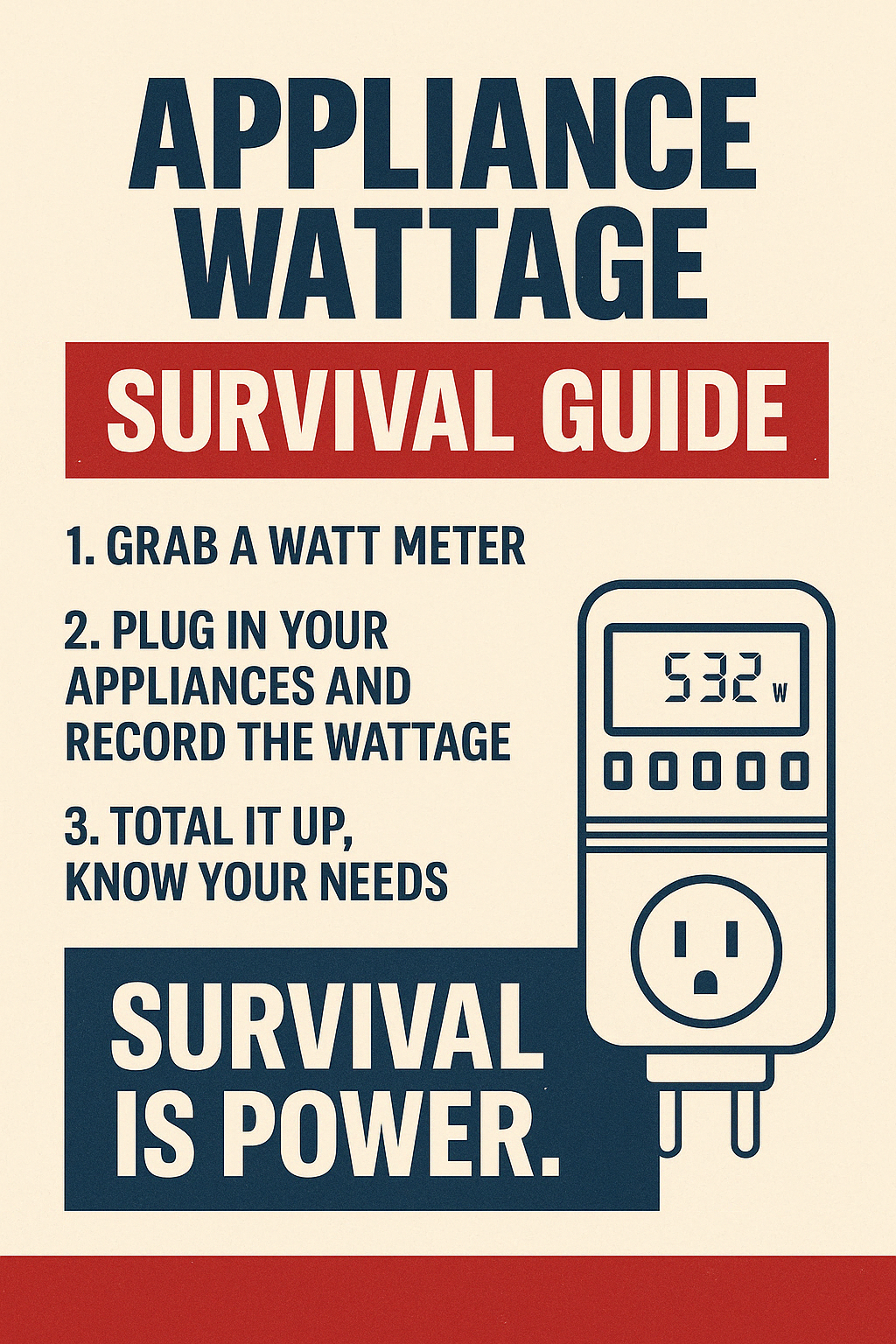
Step 6: Verify with Kill-A-Watt Meter
Some appliances lie. Labels show maximum draw, not actual usage.
Old equipment may have no readable labels at all.
Solution: plug them into a Kill-A-Watt meter.
Recommended: The Kill A Watt Electricity Usage Monitor shows exact power draw in real-time. Essential for accurate solar load calculator results.
Plug the meter into the wall. Plug your appliance into the meter.
It displays exactly how many watts that device pulls. No guessing.
Works perfect for fridges, TVs, coffee makers, anything with a plug.
Solar Load Calculator Example
Here's a typical cabin owner's solar load calculator in action:
| Appliance | Watts | Hours/Day | Wh/Day |
|---|---|---|---|
| Refrigerator | 600W | 8h | 4,800 Wh |
| LED Lights | 150W | 4h | 600 Wh |
| Television | 100W | 3h | 300 Wh |
| Laptop | 50W | 5h | 250 Wh |
| Ceiling Fan | 75W | 6h | 450 Wh |
| Total | 6,400 Wh |
Daily need: 6,400 Wh = 6.4 kWh
With 30% buffer: 6.4 × 1.3 = 8.3 kWh minimum battery capacity
This solar load calculator result tells you exactly what to buy. No guessing. No regrets.
Ready to Size Your Complete System?
Our Solar Buyer's Guide walks you from solar load calculator results to component selection.
Download Free Solar Buyer's GuideA solar load calculator turns guesswork into certainty. Six steps. Real numbers. Right-sized system.
Run the math before you spend the money. Your batteries will thank you.
Because guessing is for gamblers. You're building for survival.