

Trusted by homesteaders who need the safest cutting tool the first time.
I'm 67 years old. 5'4". I've owned several DeWalt chainsaws over the years.
Every single one bounced back on my hands. I lacked the height and strength to control them safely.
So I searched. I found the WORX JawSaw. The extension attachment sold me. I could finally reach the high branches.
I bought one. Then two. Then four. Gave three away to neighbors fighting tan tan.
If you don't know tan tan, count yourself lucky. That bush takes over entire yards. Grows along roadsides scratching vehicles. Unstoppable. Everyone around here loves to hate it.
I gave away all my other chainsaws. The JawSaw uses the same batteries as my weed wacker. Easy transition to buy all my tools from one manufacturer.
Best compliment I ever got? A man from the secluded road watched me felling trees for weeks. He finally walked up and asked, "You the only man that lives up in here?"
The damage I was doing to those dreaded tan tan trees was the legend of real men. And I'm a 5'4" woman.
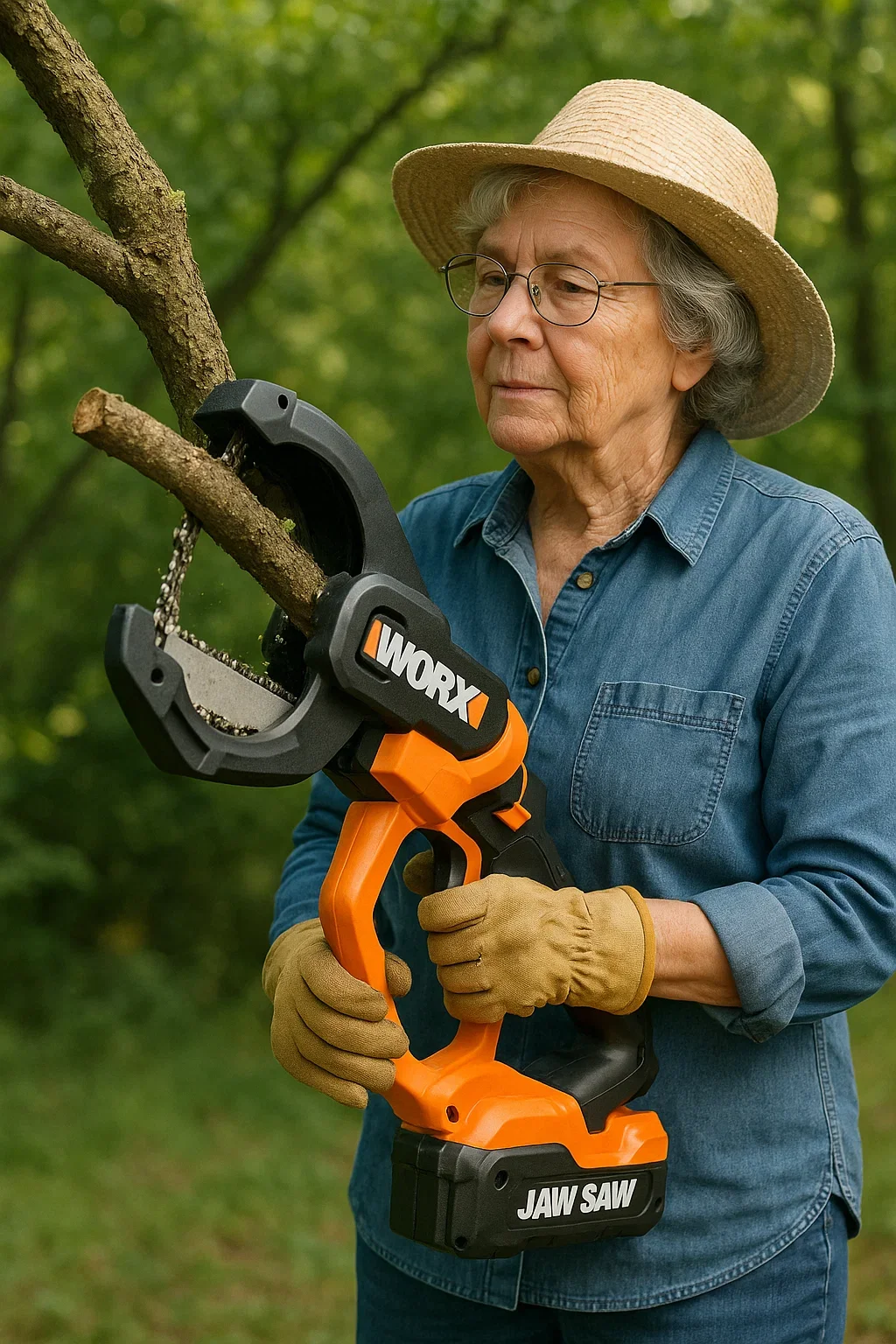
This is my WORX JawSaw review. Safety against power. The JawSaw WG320 against the DeWalt DCCS620.
Different tools. Different strengths. Same goal: getting the cutting done without losing a finger.
I ran 7 real-world tests. Here's what I learned.
TL;DR — the short version
- JawSaw wins on safety, ease of use, and weight (7.9 lbs)
- DeWalt wins on raw power and larger cuts (up to 10")
- JawSaw maxes out at 4" diameter branches
- DeWalt has a known issue: oil leaks in storage
- Best for beginners and small-stature operators: JawSaw
- Best for heavy firewood work: DeWalt
Why this review matters
The wrong chainsaw costs you money. Or worse, a trip to the hospital.
Gas saws are loud, heavy, and a maintenance headache. Cordless changed everything.
But is the JawSaw right for you? That depends on what you're actually cutting. Most homestead work is under 6 inches. Don't buy a log splitter when you need a branch trimmer.
Buy once. Buy right.
WORX JawSaw WG320: the safety-first option
The JawSaw doesn't look like a traditional chainsaw. That's the point.
WORX enclosed the blade inside a protective jaw. The chain retracts when you're not cutting. Kickback is almost impossible. That's the number one cause of chainsaw injuries gone.
What I like about the JawSaw
The enclosed blade is fully protected inside the jaw guard. I'm not afraid to use it.
It cuts on the ground. No propping branches up on sawhorses. Just clamp and squeeze.
The auto-tensioning chain stays tight without me fiddling with it. The automatic oiler has a level indicator. Less maintenance.
It weighs 7.9 lbs with the battery. Light enough for me to use for hours without my arms giving out.
Specs at a glance
- 6-inch bar length
- Cuts up to 4" diameter
- 20V Power Share battery
- ~18 cuts per charge on 4" hardwood
- 1350 RPM no-load speed
Pros: Safest design I've used. Lightweight. Cuts on the ground. Auto-tensioning. New users can pick it up and go.
Cons: Limited to 4" cuts. Less power than a traditional saw. Won't fell big trees.
DeWalt DCCS620: the power option
The DeWalt DCCS620 is a traditional chainsaw. Just without the gas.
The brushless motor delivers serious power. It handles logs up to 10 inches. It's built for people who need more than light pruning.
What the DeWalt does well
The brushless motor runs longer and lasts longer than a brushed one.
The 12-inch bar handles work that a JawSaw can't touch.
Tool-free tensioning means I can adjust the chain without hunting for a wrench.
It has the standard low-kickback bar and chain brake. Decent safety, but it's not the JawSaw.
It weighs 9 lbs with the battery. Heavier. After an hour, I feel it.
Specs at a glance
- 12-inch bar length
- Cuts up to 10" diameter
- 20V MAX battery
- ~90 cuts per charge on 4x4 treated lumber
- 25.2 ft/s chain speed
Pros: Real cutting power. Handles bigger logs. Brushless efficiency. Excellent battery life.
Cons: Oil leaks in storage. Heavier than the JawSaw. Exposed blade — standard chainsaw risk. Right-hand biased design.
The 7 head-to-head tests
I tested both saws on my property. Real cutting. Real conditions. Here's what happened.
Test 1 — Safety
The JawSaw wins. Hands down.
The enclosed blade means I can't accidentally touch the chain. It retracts into the housing when I'm not cutting. Kickback is almost impossible.
The DeWalt has a low-kickback bar and a chain brake. Effective. But conventional. If you're new to chainsaws or you're cautious like me, the JawSaw is in another category.
Test 2 — Cutting capacity
The DeWalt wins. The 12-inch bar handles what the 6-inch JawSaw can't touch.
The JawSaw maxes out at 4 inches. The DeWalt handles 10. If you're felling small trees or processing firewood, you need the DeWalt.
Test 3 — Weight and handling
The JawSaw wins. 7.9 lbs versus 9 lbs.
One pound sounds like nothing. After an hour of cutting, it's everything. The JawSaw also balances better when I'm reaching overhead.
Test 4 — Ease of use
The JawSaw wins. Clamp the jaw on the branch. Squeeze the trigger. Done.
It cuts on the ground. No propping branches on sawhorses. The DeWalt needs more skill — proper cutting angles, kickback awareness, position sense.
Test 5 — Raw power
The DeWalt wins. The brushless motor outperforms the JawSaw on every power metric.
The DeWalt's 25.2 ft/s chain speed chews through hardwood. The JawSaw's 1350 RPM works, but slower. For volume cutting, the DeWalt finishes the job faster.
Test 6 — Maintenance
The JawSaw wins. Auto-tensioning chain. Automatic oiler. Minimal fuss.
The DeWalt has a known problem. Oil leaks during storage. I've seen the puddles on my shop floor. Store it on cardboard or newspaper. Or expect a mess.
Test 7 — Value
It's a tie. The JawSaw runs $150-170 for the kit. The DeWalt runs $200-250.
The JawSaw costs less upfront. The DeWalt offers more capability per dollar. The right answer depends on what you actually cut.
Specifications side by side
| Feature | WORX JawSaw WG320 | DeWalt DCCS620 |
|---|---|---|
| Bar length | 6 inches | 12 inches |
| Max cut diameter | 4 inches | ~10 inches |
| Weight (with battery) | 7.9 lbs | 9 lbs |
| Motor type | Brushed | Brushless |
| Battery system | WORX 20V Power Share | DeWalt 20V MAX |
| Chain tensioning | Automatic | Tool-free manual |
| Safety design | Enclosed blade | Low kickback bar + chain brake |
| Price (kit) | $150-170 | $200-250 |
| Best for | Pruning, brush clearing, beginners | Firewood, small trees, heavy use |
Who should buy which saw
Buy the WORX JawSaw if you:
- Care about safety more than raw power. The enclosed blade is unmatched.
- Mostly prune and clear brush. 4-inch capacity covers most yard work.
- Are new to chainsaws. The learning curve is almost zero.
- Want a saw that's light enough for extended use.
- Are smaller in stature. I'm 5'4" and this saw works for me.
Buy the DeWalt DCCS620 if you:
- Cut larger material. Logs over 4 inches need a longer bar.
- Process firewood regularly. The DeWalt handles volume.
- Are already comfortable with traditional chainsaw technique.
- Already own DeWalt 20V batteries. The ecosystem saves you money.
- Want a brushless motor that lasts longer.
My verdict
For most homesteaders, the JawSaw is your starting point.
Eighty percent of property maintenance is branches under 4 inches. The JawSaw handles all of it safely.
Add the DeWalt later if your cutting grows beyond what the JawSaw can do. Two specialized tools beat one compromise tool every time.
This isn't about which saw is "better." It's about which saw matches your work. A 5'4" homesteader clearing storm branches needs different tools than someone processing firewood all winter.
Match the saw to your task. Your hands will thank you.
FAQ
Can the JawSaw fell trees? Only saplings under 4 inches in diameter. For larger trees, use the DeWalt or a full-size saw.
How do I stop the DeWalt oil leak? Store it bar-side up on absorbent material. Drain the oil reservoir if it's going to sit for a while.
Are the batteries interchangeable? No. WORX uses 20V Power Share. DeWalt uses 20V MAX. Different systems entirely.
Which cordless chainsaw lasts longer? The DeWalt's brushless motor typically outlasts a brushed motor. With proper care, expect a longer service life.
Can I use either saw for firewood? The DeWalt handles firewood-sized logs. The JawSaw is limited to small kindling branches under 4 inches.
Is the JawSaw good for overhead cutting? Yes. The light weight and enclosed blade make it safer for overhead pruning than a traditional saw.