Last Updated: April 13, 2026
TL;DR — The Marine Battery Trap
You cannot build a permanent off-grid home on a "floating boat" foundation. Marine batteries are a compromise between a starting battery and a deep-cycle battery. In the rigorous world of solar storage, they perform poorly at both. True off-grid reliability requires either thick-plate Flooded Lead Acid (FLA) batteries or modern Lithium (LiFePO4) storage. If your battery has "Cold Cranking Amps" (CCA) listed on the label, it is not a solar battery and will likely fail before your first winter is over.
Is your battery bank refusing to hold a charge after only one season?
You followed the advice of a big-box store. You bought the "Deep Cycle Marine" batteries because they were $120 each. Now, your inverter beeps every time the sun goes down. You haven’t failed—your gear has. This guide shows you how to stop buying "temp" batteries and build a bank that actually lasts.
Table of Contents
Construction Matters: Thin plates vs. Thick plates
A car battery has many very thin lead plates. This maximizes the surface area to provide massive current for 2 seconds. A true deep-cycle battery has fewer, much thicker lead plates.
Marine batteries are "Dual Purpose." They try to have medium-thickness plates. In an off-grid system, you discharge the battery overnight. During this discharge, the chemical reaction "eats" into the lead.
On a thin-plate marine battery, the lead is so thin that it physically falls apart (shedding) inside the case after just 50 to 100 deep-discharge cycles.
The Sulfation Death Spiral
When a lead-acid battery sits at less than 100% state of charge, lead sulfate crystals begin to form on the plates. If not cleared by a full charge immediately, these crystals harden.
This is the "Sulfation Death Spiral." It reduces the active surface area of the battery. Eventually, your 100Ah battery can only hold 20Ah of power. Marine batteries are particularly susceptible to this because they are often under-charged by high-resistance solar wiring.
The most common battery failure Wattson sees in off-grid builds is not a defective cell — it is a marine or starter battery that was never designed for daily deep cycling.
Cold Cranking Amps (CCA) vs. Amp-Hours (Ah)
Here is the secret label test:
- If the label prominently displays CCA (Cold Cranking Amps): It is a starting battery. Even if it says "Deep Cycle," it is not a solar battery.
- If the label only displays Ah (Amp Hours) and Reserve Capacity (RC): It is likely a true deep-cycle battery.
Wattson's Rule: Solar doesn't care about "cranking." We care about "capacity." If a battery is marketed for its ability to start a motor in zero-degree weather, it is built for the wrong job.
🦍 WATTSON'S BATTERY RULE: 'SIZE THE CHEMISTRY, NOT JUST THE LABEL.' "I've seen the look on a man's face when his $1,200 marine battery bank dies in October. He feels like he's been robbed. And he has. He was robbed of his independence by a marketing label. For the same $1,200, he could have bought two high-quality L16 lead-acid batteries that would have lasted him five years. Don't be the guy who buys his batteries at the same place he buys his fishing lures."
Why Marine Batteries are 'Half-Measures'
A marine battery is designed to start an outboard motor and then occasionally run a trolling motor or some lights while the engine is off.
In an off-grid home, the "engine" is never on. You are drawing power 24 hours a day and only "running" the charger (the sun) for 5 hours. Marine batteries cannot handle the depth of discharge required to survive a three-day storm.
What would solar look like for your home?
Get your exact system recommendation in minutes. Panel count, battery bank size, inverter capacity, cost range — calibrated to your address, not a national average.
SHOW ME MY SYSTEM →How to verify a true deep-cycle battery
If you are staying with lead-acid, look for L16 or GC2 (Golf Cart) batteries from brands like Trojan, Rolls, or Crown. These have the thickest plates in the industry.
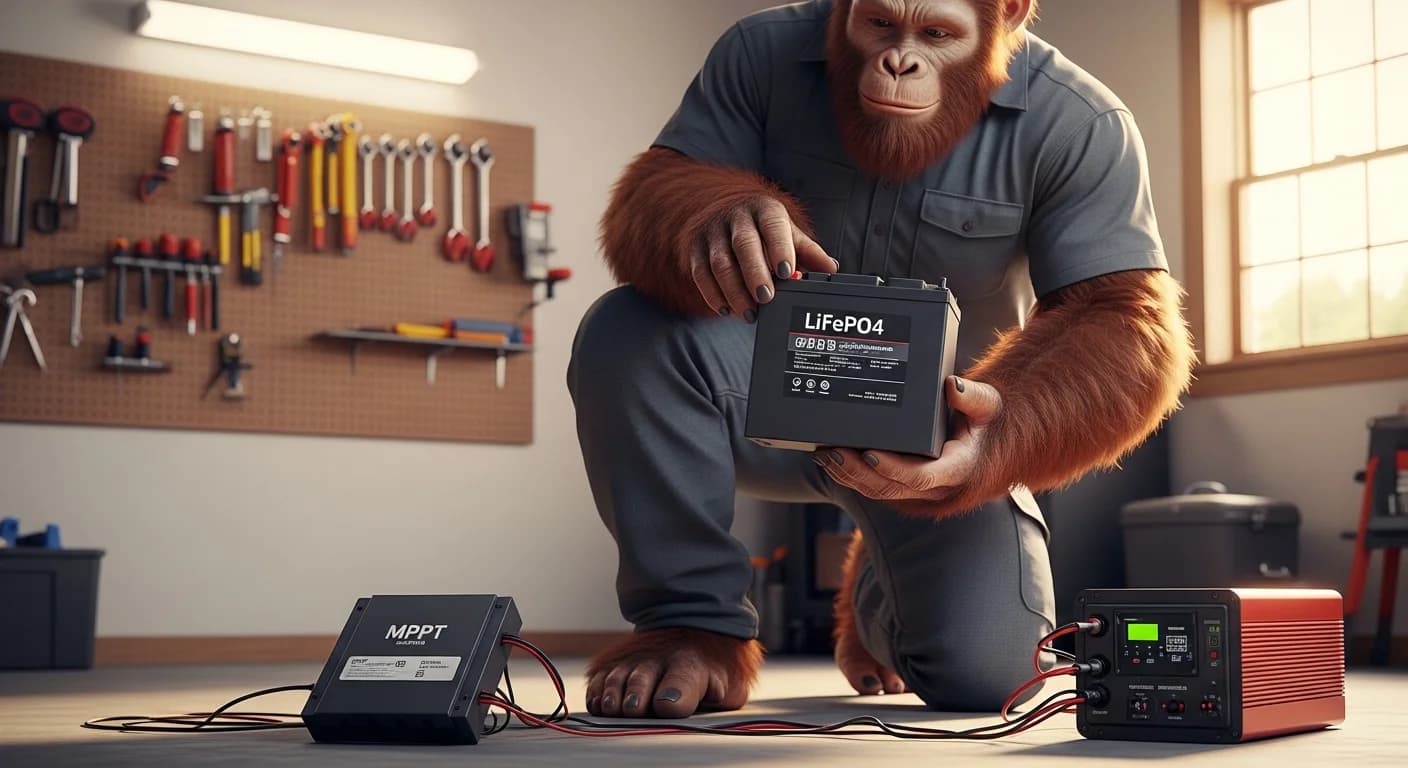
If you want to end battery failure forever, move to LiFePO4 (Lithium Iron Phosphate). Lithium doesn't sulfate, doesn't shed plates, and can be discharged to 0% without permanent damage. While the upfront cost is higher, our LiFePO4 vs AGM cost comparison shows that lithium is actually cheaper over the long haul, especially if you use high-density lithium server rack batteries for your main storage bank.
The homesteader in Idaho watching his winter production crater. The veteran in Michigan who refuse to be dependent on a grid that fails. The father in Tennessee who knows his family's safety depends on his gear. This guide is for them.
Frequently Asked Questions
How long do marine batteries last in a solar system?
In a high-use off-grid home, a marine battery typically fails within 6 to 12 months. They are not built for the deep, daily discharge cycles required for energy independence, causing the plates to shed and the battery to lose capacity rapidly.Why does my marine battery beep my inverter at night?
This is a low-voltage warning. Marine batteries have high internal resistance; as they discharge, their voltage "sags" significantly under load. When your refrigerator kicks on at night, the voltage drops below the inverter's cutoff, even if the battery isn't completely empty.Can I use car batteries for my off-grid solar?
Never. A car battery will physically fail within 30 to 50 cycles in a solar application. They are designed for 3% discharge and immediate recharge. Off-grid solar requires 50% to 80% discharge, which destroys car and marine batteries almost instantly.What is the best type of battery for off-grid solar?
For the best value and longevity, Lithium Iron Phosphate (LiFePO4) is the current gold standard. If you prefer lead-acid, use "industrial" deep-cycle batteries like GC2 golf cart batteries or L16 6V units wired in series.Why is my off-grid battery bank getting hot when charging?
Heat is a sign of internal resistance and potentially shorted plates (often caused by shedding in marine batteries). If your batteries are hot to the touch while charging, they are failing and may even be a fire hazard. Disconnect and replace them with true deep-cycle units.Don't build your independence on a 'dual-purpose' lie.
A marine battery is a compromise that leaves you in the dark. If you are serious about off-grid living, you need gear that handles the heavy lifting of deep, daily cycles. Invest in thick-plate lead-acid or modern lithium storage. Your battery bank is the heart of your home—don't let it stop beating in the middle of winter.
🦍 WATTSON ON WINTER SURVIVAL: "Most people think they need more panels when their power runs low in January. Usually, they just have batteries that have sulfated to the point of being paperweights. You can't charge a battery that won't hold it. Buy the right chemistry first, or spend your life chasing 'low voltage' alarms."
You are a provider for your family.
You didn't build this to be a struggle; you built it to be a solution. Avoiding off-grid battery failure is the first step toward true seasonal independence. Get the right storage, get your numbers right, and stay powered.
"Have a question about a specific battery brand or a low-voltage alarm you're hearing tonight? Our AI Guide handles those troubleshooting details." Get specific advice from Wattson →