TL;DR — Solar batteries that survive off-grid duty
This guide ranks five solar batteries field-tested across off-grid cabins, ranches, and prepper setups from Montana to Texas. The audience is patriots running cabins or full homes without grid backup, and homesteaders sizing a first bank of solar batteries. LiFePO4 wins on lifespan, weight, and cold-weather performance. Lead-acid solar batteries cost less today and more over a decade. Use the sizing math at the bottom before clicking any buy button.
It was nine days into the blackout when Tom's neighbor walked over. The neighbor's generator had run dry on day three. His freezer was warm. His insulin was sweating in a cooler full of melting snow. The propane truck was a hundred and forty miles south, blocked by a road no plow had touched. Tom's lights were on. His well pump was running. His chest freezer was humming. A pot of stew sat warm on the stove. Inside Tom's mudroom, four Battle Born 100Ah LiFePO4 batteries sat quiet against the wall. They had charged that morning off panels still half-buried in snow. That cabin is in Montana. The blackout was real. The batteries are the reason this article exists.
Who this is for
This guide is for the rancher outside Tulsa who watched cattle water freeze during a winter blackout and swore never again. The Florida hurricane survivor in Cape Coral who waited twelve days for the lights to come back. The wildfire-zone family in Northern California who packs the truck every August. The Texas homeowner who remembers pipes bursting during the freeze and hearing silence where the furnace hum should be. The retired couple in rural Arizona whose insulin needs to stay cold. The blue-collar dad in Ohio whose sump pump failed the night the storm rolled through. The prepper who never talks about it. The neighbor who used to think backup power was overkill — until it wasn't.
For years, responsible homeowners were told blackouts were rare. Then the grid failed.
For years, families were told solar was for hippies. Then hurricane season proved otherwise.
For years, batteries were treated as optional. Then they became survival.
If you protect your home, this guide is for you. Regardless of how you voted. Regardless of whether your neighbors get it. The grid does not discriminate when it fails. Preparedness unites.
Why solar batteries matter
Panels make power when the sun shines. Solar batteries store it for everything else — night, storms, the four-day cloud bank that rolls in every November.
Without solar batteries, your system is daylight-only. Useless when you need it most.
I learned this the expensive way. My first bank was bargain lead-acid solar batteries. Six golf-cart units. Maintenance every month. Watering the cells. Equalizing charges. By year two the capacity was already dropping. By year four they were scrap.
The replacement cost more than the original system. Quality solar batteries would have saved thousands and a hundred Saturday mornings.
The numbers that decide everything
Lead-acid solar batteries deliver 500–800 cycles before serious degradation. LiFePO4 solar batteries deliver 3,000–6,000.
That is the difference between two years and twelve.
Depth of discharge tells the rest of the story. Lead-acid dies fast below 50% charge. LiFePO4 handles 80–100% safely. You get double the usable power from the same nameplate capacity.
Lithium iron phosphate (LiFePO4) now dominates new residential storage installations precisely because the cycle economics changed the math. Once cost-per-cycle dropped below lead-acid, the conversation was over.
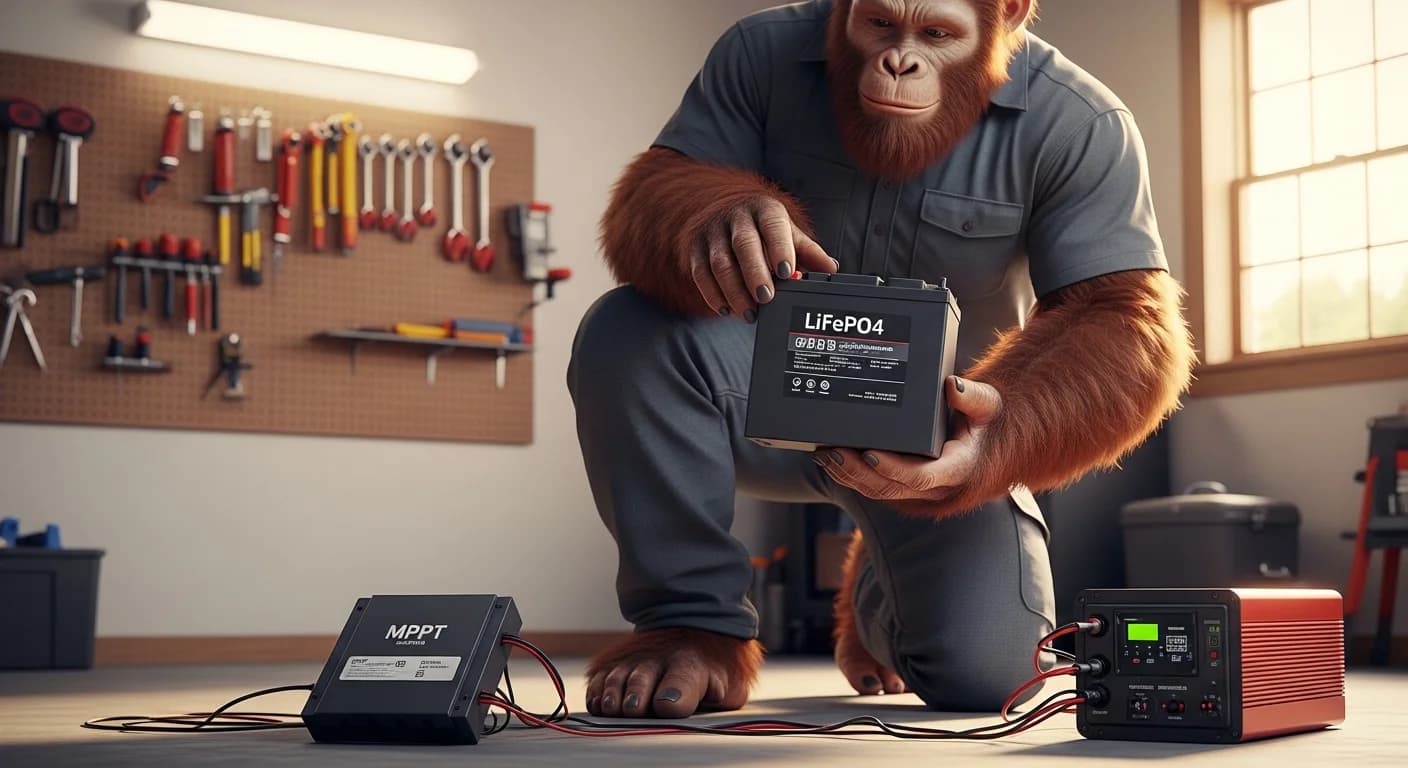
WATTSON'S BATTERY TRUTH: Cheap batteries cost more. I've watched folks replace bargain batteries three times in the years their LiFePO4-running neighbors replaced none. They spent more on cheap than quality would have cost once. The cabin that survived last winter's nine-day blackout was running Battle Born. The one that didn't was running Amazon specials. Trust the sasquatch on this one. Spend the money once.
What to look for in solar batteries
Specs sell. Performance survives. These four numbers separate reliable solar batteries from regrettable ones.
Cycle life and real warranty
Quality LiFePO4 guarantees 3,000+ cycles. Premium units reach 5,000–6,000. The warranty needs to match the spec sheet — ten years means the company actually backs the cycle claim. Three-year warranties on 5,000-cycle batteries mean the company is hedging.
Battery management system
The BMS protects your investment from itself. Overcharge protection. Over-discharge cutoff. Cell balancing. Low-temperature charging lockout. Without a real BMS, one bad cell takes the whole bank down. Premium batteries publish their BMS specs. Cheap ones do not.
Temperature range
Standard lithium will discharge from -4°F to 140°F. Charging is where it gets dangerous — below 32°F, charging lithium permanently damages the cells unless the battery has internal heating. Cabins in Montana, Idaho, or the Dakotas need self-heating models. Phoenix backups do not.
Expandability
Power needs grow. The cabin becomes a workshop. The workshop becomes a residence. The residence adds a chest freezer, a deep well pump, a Starlink dish. Choose batteries that parallel cleanly with matching voltage and capacity. Mismatched banks fail in odd ways.
Top 5 solar batteries tested for off-grid power
These five earned their spots through actual installations, not press releases.
1. Battle Born 100Ah LiFePO4 — Best Overall
Battle Born builds in Reno, Nevada. American workers. American quality control. Customer service that answers the phone on Tuesday afternoon.
- 100Ah usable capacity at 100% depth of discharge
- 3,000–5,000 cycle lifespan
- Internal BMS with low-temp protection
- 10-year warranty honored without arguments
- Discharge to -4°F, charge above 25°F
- Drop-in replacement for Group 27 lead-acid
These are the batteries that powered the Montana cabin through the nine-day blackout. They held. The owner has run them five winters and still measures full capacity.
2. Renogy Smart Lithium — Best Value
Renogy delivers solid LiFePO4 at a reasonable price. Bluetooth monitoring included. Not premium, but honest.
- 100Ah and 200Ah options
- 4,000+ cycles at 80% DoD
- Bluetooth app shows real-time charge
- Self-heating variant for cold climates
- 5-year warranty with US support
- Parallels cleanly up to 16 batteries
The Bluetooth tells you exactly where your reserves sit. No more guessing whether you can run the well pump tonight.
Browse Renogy solar batteries →3. Victron BMV-712 Monitor — Best Visibility
Victron does not make batteries. Victron makes the brain that watches your batteries. Pair this with any LiFePO4 bank for professional-grade visibility.
- State of charge, voltage, current, draw, time-to-empty
- Bluetooth to the VictronConnect app
- Programmable relay for low-voltage alerts
- Historical data logging
- Works on 12V, 24V, and 48V systems
Knowledge prevents disaster. The Victron tells you what your bank is doing before something dies.
Get the Victron BMV-712 →4. Anker Solix F3800 — Best All-In-One
The Anker combines battery, inverter, and charge controller in one box. No wiring. No electrician. No permits in most jurisdictions.
- 3,840Wh LiFePO4 capacity
- 3,000+ cycle lifespan
- 6,000W surge, 3,600W continuous
- Expandable to 26.9 kWh with add-on batteries
- 120V and 240V output
- Accepts up to 2,400W of solar input
Whole-house backup for renters, condo owners, and anyone who wants a working system this weekend.
Check Anker Solix F3800 price →5. My Patriot Supply Power — Best for Preppers
My Patriot Supply builds systems aimed at preppers, not hobbyists. Plug-and-play with food and water storage as a complete solution.
- Pre-configured emergency systems
- Designed for grid-down scenarios
- Expandable architecture
- American company with patriot values
- Bundles with food, water, and medical storage
If you think in three-month outages instead of three-day storms, these match the mindset.
See Patriot Power systems →Comparison chart
| Battery | Capacity | Cycles | Warranty | Best For |
|---|---|---|---|---|
| Battle Born 100Ah | 100Ah usable | 3,000–5,000 | 10 years | Cold-climate cabins |
| Renogy Smart Lithium | 100Ah–200Ah | 4,000+ | 5 years | Budget-conscious DIY |
| Victron BMV-712 | N/A (monitor) | N/A | 5 years | Bank visibility |
| Anker Solix F3800 | 3,840Wh | 3,000+ | 5 years | Renters and condos |
| Patriot Power | Varies | 3,000+ | Varies | Full preparedness |
How to size your solar battery bank
Sizing matters more than brand. An undersized Battle Born fails the same way as an undersized golf-cart battery — by leaving you in the dark.
Step 1: Calculate daily load
List every device. Note wattage and runtime. A 100W laptop running 10 hours uses 1,000Wh. A 1,500W well pump running 30 minutes a day uses 750Wh. Add it all up. Include the small stuff.
Step 2: Add system losses
Inverters lose 10–15% to heat and conversion. Charge controllers lose 5–10%. Multiply your daily load by 1.25 to cover the gap.
Step 3: Plan backup days
Cloudy weather happens. Two backup days doubles your storage need. Mountain locations and northern latitudes need three. Coastal hurricane zones need four.
Step 4: Apply depth of discharge
LiFePO4 handles 80% DoD safely. Divide your total requirement by 0.8 to get actual nameplate capacity needed.
Worked example: 5,000Wh daily load × 1.25 system loss × 2 backup days ÷ 0.8 DoD = 15,625Wh nameplate. That's roughly four 100Ah/12V LiFePO4 batteries wired in a 48V configuration, or two 200Ah/24V units.
WATTSON'S SIZING SECRET: Buy more than you need. Every off-gridder I've ever met wishes they bought more capacity. Your loads grow. Your comfort expectations grow. That "extra" 25% becomes baseline within a year. Build for future you. The contractor who undersized my first system cost me $15,000 when the batteries melted from running a kettle the system was never designed to handle. Been off-grid since 2011. Trust me on this.
Common solar battery buying mistakes
These mistakes cost good people thousands. Learn from the wreckage.
Mistake 1: Buying on price alone
The cheapest battery on Amazon uses the cheapest cells the manufacturer could source. Cheap cells degrade fast. Calculate cost per cycle before buying. A $900 battery with 4,000 cycles costs $0.22 per cycle. A $200 battery with 500 cycles costs $0.40 per cycle. Plus three replacement weekends.
Mistake 2: Ignoring temperature
Standard lithium refuses to charge below 32°F to protect itself. If your battery shed hits freezing, you need a heated model or you need indoor placement. Charging cold lithium permanently destroys the cells.
Mistake 3: Wrong charge profile
LiFePO4 needs a charge controller set to LiFePO4 profiles. Lead-acid profiles overcharge lithium and trigger BMS shutdowns at best — fires at worst. Confirm controller compatibility before you wire anything.
Mistake 4: Undersizing
Power consumption grows. The cabin becomes a home. The home adds a chest freezer. Buy 25–50% more nameplate than your calculations show. Future you will thank present you.
LiFePO4. AGM. Flooded lead-acid. The choice shapes the whole system.
Battery chemistry sets your cycle life, your depth-of-discharge limits, your charge profile, and your replacement schedule. The component guide walks the tradeoffs honestly.
COMPARE BATTERIES →Get the Free Solar Buyer Checklist
Every question to ask before buying any solar component — panels, batteries, inverters, and charge controllers. Free download.
GET THE FREE BUYER CHECKLIST →FAQ
How long do solar batteries last?
LiFePO4 solar batteries last 10–15 years with proper care, delivering 3,000–6,000 cycles. Lead-acid fails after 3–5 years in typical off-grid duty.
What size battery bank do I need for a cabin?
A typical off-grid cabin uses 5–10 kWh daily. Multiply by your desired backup days, divide by 0.8 for LiFePO4 depth of discharge, and add 25% buffer. Most cabins land between 10–20 kWh of nameplate storage.
Can solar batteries charge in cold weather?
Most lithium stops charging below 32°F to protect cells from damage. Premium models include internal heaters that engage automatically. If your storage location freezes, buy heated batteries or relocate the bank.
Are expensive solar batteries worth it?
Calculate cost per cycle. A $900 LiFePO4 with 4,000 cycles costs $0.22 per cycle. A $200 lead-acid with 500 cycles costs $0.40 per cycle. The expensive battery is the cheap one.
LiFePO4 vs lead-acid: which is better?
LiFePO4 wins on lifespan, weight, usable capacity, and maintenance. Lead-acid wins on upfront cost. Over a 10-year horizon, LiFePO4 wins on total cost too.
Can I mix old and new batteries in the same bank?
No. Mixed banks degrade to the level of the weakest battery. Replace the whole bank when one fails, or wire new batteries in a separate parallel string with its own charge controller.
How many batteries do I need for a refrigerator during a blackout?
A modern Energy Star fridge uses 1–2 kWh per day. One 100Ah/12V LiFePO4 battery (1.2 kWh usable) runs a fridge roughly 12–18 hours alone. For full grid-down coverage, plan for at least 4 days of fridge runtime in your sizing math.
Do I need a permit to install solar batteries?
It depends on your state and your inverter. Plug-and-play systems like the Anker Solix often need no permits. Wired systems with grid interconnection require NEC-compliant installation and inspection. Check with your local AHJ before pulling wire.
Can I install solar batteries myself?
Yes, with the right knowledge and respect for the voltages involved. A 48V LiFePO4 bank can deliver hundreds of amps of fault current. Use proper fusing, follow NREL's safe practices guidance, and don't skip the disconnect.
What happens to solar batteries in a fire?
LiFePO4 chemistry is dramatically more thermally stable than the lithium-ion in laptops or EVs. It does not catastrophically vent. It can still burn given enough external heat, so house batteries in non-combustible enclosures with proper ventilation.
Buy chemistry first, brand second
Quality solar batteries deliver energy independence. They cost more upfront. They cost less per cycle. They outlast cheap alternatives by a decade.
Battle Born sets the American standard for off-grid LiFePO4. Renogy delivers value without cutting corners. Victron makes the brain that watches the whole bank. Anker makes the all-in-one for renters. Patriot Power builds for preppers who think in months, not days.
Your battery bank powers your independence. Buy chemistry first. Buy brand second. Size for the home you'll have in five years, not the cabin you have today.
The next grid failure is coming. Be the cabin with the lights on.
The complete Component Selection guide →