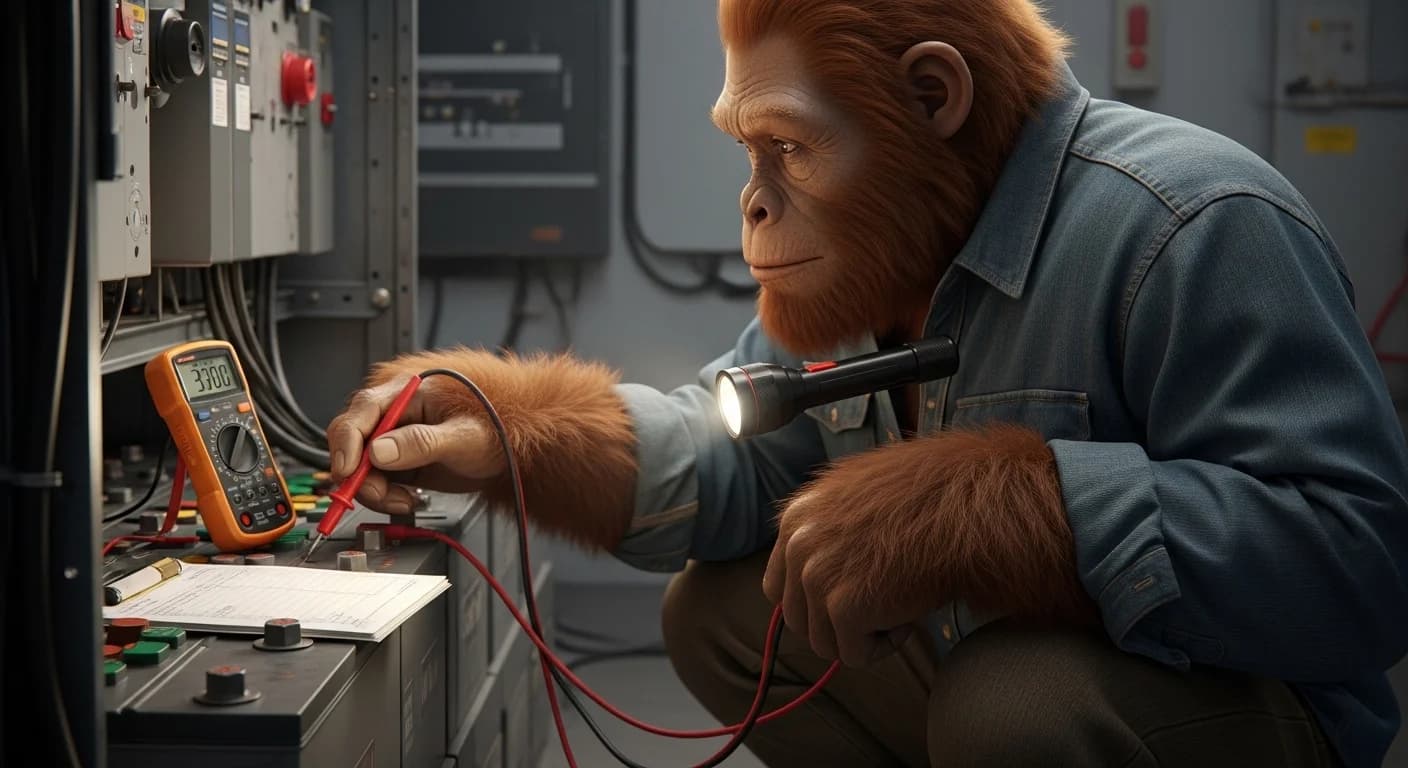
TL;DR - Battery terminal torque inspection in 30 minutes
Battery terminal torque inspection is the cheapest fire-prevention task in off-grid solar. Every battery lug works loose over time from thermal cycling, vibration, and corrosion. A lug 20 percent under spec carries enough resistance to generate fire-starting heat under full load. The inspection sequence: calibrated torque wrench set to manufacturer spec (typically 95-110 inch-pounds for 5/16 inch posts, 200-240 inch-pounds for 3/8 inch posts), applied to every lug in a documented sequence every 6 months on lead-acid, annually on lithium. Each lug gets the wrench until it clicks. Anything that tightens before the click was below spec. Document every reading. Re-torque any lug that needed adjustment, then verify with a thermal scan during the next peak-load period. The torque wrench costs $40 and prevents the most preventable fires in residential solar.
The hired contractor charged her $4,800 to install eight Battle Born LiFePO4 batteries in series-parallel. He worked alone, finished the install in six hours, handed her a single page of receipts and left. Eleven months later her inverter started alarming on intermittent low-voltage at random times - twice during dinner, once at 3 AM, twice during the dishwasher run. The local solar tech she called pulled a torque wrench out of his truck and went straight to the battery bank. Within ten minutes he had a number: three of the sixteen lugs were below 60 inch-pounds. Manufacturer spec was 95. One lug was barely finger-tight, generating 22 degrees F more heat than its neighbors under load. The contractor had snugged every connection by hand and called it good. No torque wrench. No documented sequence. Eleven months of slow heat had already brown-stained the heat-shrink on two cables, and the contractor was three hours away and not returning her calls. The tech spent forty-five minutes properly torquing every lug in the bank to spec, cleaning two terminals with baking soda where the loose lugs had let corrosion start, and writing the readings in a notebook she could reference next time. The whole visit cost her $185. The contractor's six-hour install had left her ten weeks from a structure fire. The torque wrench in the tech's truck cost $42 retail. That was the math she hadn't understood until that afternoon.
Who this is for
This guide is for the Tennessee homeowner who paid a contractor $4,800 to install batteries and ended up paying another tech to fix what the contractor never properly torqued. The Florida coastal family whose salt-laden humidity accelerates corrosion at every metal junction and demands tighter inspection intervals than inland systems. The Arizona homesteader whose 50-degree daily temperature swings expand and contract every lug in his battery bank twice a day, working perfectly-tight connections loose over years. The Vermont retiree whose unheated battery shed cycles from 90 degrees F in August to -10 degrees F in January, putting more mechanical stress on lugs than any other climate condition. The Texas first-time off-gridder who watched a YouTube install video that never once mentioned torque values. The Colorado mountain homeowner whose system was commissioned during summer build season and has never had its lugs re-torqued in the four winters since. The Oregon DIY-er who built his own system, bought every tool except the torque wrench, and assumed "as tight as I could turn it" was the same as "to spec." The Pennsylvania DIYer who inherited a system from the previous owner with no commissioning documentation and no way to know whether any lug was ever torqued correctly.
Three things are true of every one of them.
The lug that fails is the one nobody has touched since commissioning.
A torque wrench costs less than a single emergency electrician visit.
The most common cause of off-grid fires is the cheapest one to prevent.
Why "hand-tight" is not "to spec"
The human hand reliably detects roughly 20 percent deviation from a target torque on small fasteners. For the heavy lugs in a battery bank, the deviation is worse - up to 30-40 percent on the larger sizes. A lug that feels tight to your hand can be far below manufacturer spec.
The reason matters because of physics. Every electrical connection makes contact across a microscopic surface area. Properly torqued lugs make contact across millions of tiny points, distributing current evenly and generating minimal heat. Under-torqued lugs make contact across a fraction of that area, forcing the same current through fewer contact points, which creates resistance, which generates heat.
The heat starts a runaway cycle. Heat oxidizes the copper at the connection surface. Oxidation reduces the effective contact area. Reduced contact area increases resistance. Increased resistance generates more heat. The lug works its way to a failure mode that starts as warm-to-the-touch and ends as a DC arc fault hot enough to ignite cable insulation.
According to National Renewable Energy Laboratory field research on PV system reliability, connection-related thermal anomalies precede visible damage by 60 to 180 days. That means a loose lug today is a fire risk in three to six months - but only if nothing changes. With proper torque inspection, the loose lug gets caught and corrected before any heat develops.
The torque wrench is the only tool that detects under-spec connections before they generate heat. The IR thermometer catches the failure after heat has started. Visual inspection catches the failure after damage is visible. Of those three diagnostic tools, the torque wrench is the only one that prevents the failure from happening at all.
WATTSON'S TORQUE TRUTH: At the US Solar Institute the instructor demonstrated something I never forgot. He took a standard 5/16 inch battery lug, attached it to a test rig wired to draw 100 amps under load. He hand-tightened it as tight as a strong man can turn it without tools. The connection looked perfect. Within four minutes the lug measured 38 degrees F above ambient. Then he applied a torque wrench set to 95 inch-pounds - the manufacturer spec. The lug tightened measurably before the wrench clicked. Same lug, same wires, same load, properly torqued: 6 degrees F above ambient after four minutes. Eighty percent less heat. That was the lesson. "Tight" is not "to spec." After fifteen years off-grid I have never installed or inspected a battery bank without a calibrated torque wrench, and I have never had a connection-related fire. The wrench costs $40. The fire it prevents costs everything.
Stop the fire before it starts with the right torque.
Wattson's Battery Terminal Torque Reference Card - the printable spec table for every common battery type, the documented inspection sequence, and the seasonal schedule that catches loose lugs before they become arc faults.
GET THE TORQUE CARD ->The battery terminal torque values that matter
Every battery manufacturer publishes a specific torque value for their terminals. Use the manufacturer spec when available - it's printed on a label inside the battery cover, in the manual, or on the manufacturer website. When no manufacturer spec is available, use these industry default values.
Common torque specs by terminal type
| Terminal type | Common applications | Torque range |
|---|---|---|
| 1/4 inch stud | Small AGM batteries, some lithium BMS terminals | 50-70 inch-pounds |
| 5/16 inch stud | Standard 100Ah-200Ah AGM and lithium | 95-110 inch-pounds |
| 3/8 inch stud | Large lead-acid, golf-cart batteries, big lithium | 200-240 inch-pounds |
| 1/2 inch stud | High-capacity industrial batteries, bus bars | 480-600 inch-pounds |
| M6 metric | European-spec lithium and BMS units | 90-110 inch-pounds |
| M8 metric | Larger European-spec lithium | 180-220 inch-pounds |
| M10 metric | Largest industrial lithium | 360-440 inch-pounds |
Specific manufacturer specs always override these defaults. Battle Born LiFePO4 specifies 96 inch-pounds for the standard 3/8 inch terminal post. Victron Lynx Distributor specifies 96 inch-pounds for M8. Trojan flooded specifies 100-120 inch-pounds for the 5/16 SAE post. Read the spec for your specific equipment.
Why over-torquing is just as dangerous
Going past spec causes a different failure mode. Overtightening can strip the threads on the terminal post, crack a lead post on flooded batteries, deform a copper lug to the point where it loses contact with the mating surface, or create stress fractures in the brass insert of a lithium terminal that show up months later as a sudden loss of contact. A torque wrench prevents both failure modes - it stops at the spec value, no matter how hard you push.
Never use a regular wrench or socket on battery terminals. The torque wrench is the only tool that protects both the connection and the equipment.
The battery terminal torque inspection sequence
A proper battery terminal torque inspection follows a documented sequence so you can compare today's readings to last quarter's readings and catch the slow-developing problems.
Before you start - safety setup
- Verify the battery bank is in a safe operating state - no fault codes, no smoke, no swelling, no leaking, no warm cases
- Open the DC disconnect between the battery bank and the inverter
- Open the DC disconnect between the charge controller and the battery bank
- Wait 60 seconds for any capacitor discharge
- Verify zero voltage at the inverter input terminals with a multimeter before touching anything
- Remove all rings, watches, and metal jewelry
- Wear safety glasses and Class 0 electrical-rated gloves
- Have baking soda and water available in case of any electrolyte contact
The sequence itself
- Number every terminal in the bank. Use masking tape and a Sharpie. For a 4-battery series-parallel bank you have 8 battery terminals plus the bus bar lugs and shunt connections - typically 12-16 numbered points.
- Set the torque wrench to manufacturer spec for the terminal type you're working on. Verify the setting twice before applying.
- Apply the wrench to terminal #1. Tighten until the wrench clicks. If the wrench clicks immediately (the lug was at or above spec), document the reading as "at spec - no movement." If the wrench tightens measurably before clicking, document the reading as "below spec - X amount of movement."
- Move to terminal #2. Repeat.
- Work the sequence in numerical order. Never skip back and forth - the sequence matters for documentation comparison.
- Document everything. Write in a notebook or spreadsheet: date, terminal number, torque setting, observation (at spec or below spec), any visible corrosion or discoloration.
- After all terminals are torqued, run a thermal scan during the next peak-load period. Any terminal that needed re-torquing gets a baseline reading recorded. Compare at the next quarterly inspection.
- Re-energize the system in reverse order - close the charge controller breaker first, verify normal operation, then close the inverter breaker.
The whole inspection takes 30-45 minutes for a typical residential bank. After your first inspection you'll have a baseline. Every subsequent inspection compares against that baseline and reveals which terminals are working loose faster than the others.
When to run battery terminal torque inspection
Frequency depends on chemistry and environment.
- Lead-acid (flooded, AGM, gel): every 6 months minimum, more often in coastal or extreme-climate locations
- LiFePO4 lithium: every 12 months
- After any seismic event or vehicle impact near the equipment
- After any system modification - new batteries, new cables, new shunts, new disconnects
- Any time the inverter or charge controller throws an unexplained fault code
- Any time you notice voltage drop greater than 0.5V between battery terminals and inverter input under load
- Any time a thermal scan reveals a connection running 10 degrees F or more above the cable feeding it
Coastal locations should add an extra inspection cycle annually because salt-air corrosion accelerates the loosening process. Extreme-cold climates that see large day-to-night temperature swings work lugs loose faster than mild climates. Adjust your schedule to the conditions.
What battery terminal torque documentation reveals
The point of writing down every reading isn't bureaucratic. It's pattern recognition. After three or four inspection cycles you'll see which terminals consistently need re-torquing and which stay at spec. The patterns reveal physical truths about the install.
- One terminal always loose: the post itself may be damaged, or the cable may be putting mechanical stress on the connection from a poor cable run
- All terminals on one battery loose: that battery may have manufacturing defects in the post threads, or the battery may be cycling thermally more than its neighbors due to position in the bank
- Whole bank progressively loosening over multiple cycles: the equipment space may have excessive vibration (table saws, refrigerators, generators nearby) that the install never accounted for
- Lugs that go loose only in winter: thermal contraction is winning - the lugs were torqued at summer temperatures and the bank shrinks enough in winter to back them off
Each pattern points to a different root cause and a different long-term fix. Without documentation you can't see the pattern. With documentation you can fix the underlying problem instead of just re-torquing the same lugs every six months.
When to stop and call a pro
Stop immediately and call a licensed solar electrician if any of these conditions are present during inspection.
- A battery case is bulging, leaking, or warm to the touch
- A terminal post is visibly bent, cracked, or showing exposed lead/copper from inside
- Insulation on any cable shows brown discoloration, bubbling, or scorch marks
- A lug feels loose even after torquing to spec (the threads have stripped and the lug can't hold the spec)
- You smell rotten eggs (hydrogen sulfide from a failing lead-acid cell), ozone, or burning plastic
- You see white or green corrosion that has spread beyond the immediate terminal area
- The torque wrench reaches its maximum setting before clicking on a lug that should be at standard spec (something is mechanically wrong with the terminal)
- You see any indication of arc damage - small carbon-black pits on terminal surfaces
These conditions mean you've crossed from routine maintenance into electrical hazard territory. Open the main DC disconnect, ventilate the space, and call a US Solar Institute-trained tech or licensed electrician.
Frequently asked questions
What's the difference between in-pounds and ft-pounds for battery torque? Inch-pounds and foot-pounds are different units. 12 inch-pounds equals 1 foot-pound. Most battery terminal specs are in inch-pounds (95-240 typical), not foot-pounds. Using a foot-pound wrench set to "95" on a 95 inch-pound spec lug will overtighten by 12x and destroy the terminal. Verify the units before applying torque.
Do I need two torque wrenches? Yes for most installations. A 1/4 inch drive inch-pound wrench (range 20-200 inch-pounds) handles battery terminals and breaker lugs. A 3/8 inch drive foot-pound wrench (range 10-80 foot-pounds) handles larger bus bar lugs and main disconnect terminals. Combined cost is typically $80-120 for quality units.
Can I calibrate my torque wrench at home? Not reliably. Click-type torque wrenches require periodic calibration on a calibration stand. Most quality wrenches stay within spec for 5,000 cycles or 2 years of normal use, whichever comes first. If your wrench has been dropped or used heavily, send it to a calibration service. The Klein Tools KTH4015 and Tekton 24330 both come with calibration certificates from the factory.
My battery manufacturer didn't publish a battery terminal torque spec. What do I do? Use the default values in the table above based on terminal stud size. Email the manufacturer for confirmation and document the response. If the manufacturer is out of business (which happens with off-brand batteries), use industry defaults and document your decision so future inspections have a baseline.
Should I use anti-seize compound on battery terminals? No. Anti-seize compounds are electrically insulating and will reduce contact area at the connection. For corrosion prevention, apply dielectric grease or terminal protectant (CorrosionX, NO-OX-ID) only to the perimeter of the connection after torquing - never between the conducting surfaces.
How often should I retorque a brand-new install? Three times in the first year: at 30 days, at 90 days, and at 180 days. New connections settle as the metal compresses under load and as initial corrosion develops. After the first year, transition to the standard 6-month (lead-acid) or 12-month (lithium) schedule.
Can I check torque without disconnecting the system? No. Apply a torque wrench to a live battery terminal and you risk shorting the wrench to an adjacent terminal, the case, or ground. The consequences range from blown fuses to severe arc burns. Always open the disconnect, verify zero voltage, then work.
My lugs feel loose but the wrench clicks immediately - what's happening? The lug may have stripped threads, or the cable terminal may have deformed and is no longer making proper contact even at spec torque. Remove the lug, inspect the terminal post and cable end. If either is damaged, replace before reassembling. A click at spec on a damaged terminal is a false positive.
Should I use a beam-style or click-style torque wrench? Click-style for routine maintenance. The audible click and tactile feedback are unmistakable - you know exactly when you've hit spec. Beam-style wrenches require visual reading at the moment of torque, which is awkward inside a battery enclosure. Quality click-style wrenches like the Klein KTH4015 or Tekton 24330 are accurate within 4 percent and last for years of light use.
What if I find a terminal that's tighter than spec? Document the finding but don't loosen it. Over-torque doesn't cause immediate damage if the terminal hasn't been overstressed yet. At the next inspection cycle, the over-torqued lug should fall back into spec range as the connection settles. If it stays significantly over spec across multiple inspections, replace the lug - the threads may have been stretched permanently and won't release at spec.
How do I know if my batteries even have torque specs? Check inside the battery case lid first - many manufacturers print torque specs on a label there. Then check the manufacturer manual (often online if you've lost the paper copy). Then check the manufacturer website FAQ. Then email the manufacturer directly. Document the source of every torque value you use for future reference.
Conclusion
Battery terminal torque inspection is the cheapest fire-prevention task in off-grid solar. The torque wrench costs $40 and the inspection takes 30-45 minutes twice a year. The fire it prevents costs everything.
Every battery lug works imperceptibly loose over time. Thermal cycling, vibration, corrosion - they all conspire to back off connections that were perfectly tight on commissioning day. The lug that fails isn't the one you can see. It's the one nobody has touched since the contractor walked away.
The battery terminal torque inspection sequence is simple and consistent. Set the wrench to manufacturer spec. Apply to every terminal in a documented numerical order. Record every reading. Re-torque anything below spec. Verify with thermal scan at the next peak-load period. Compare quarter-over-quarter to catch slow-developing problems before they become arc faults.
The torque wrench is the only diagnostic tool that prevents the failure rather than catching it after damage has started. Use it. Document the readings. Save the bank.
The complete Maintenance & Troubleshooting guide ->