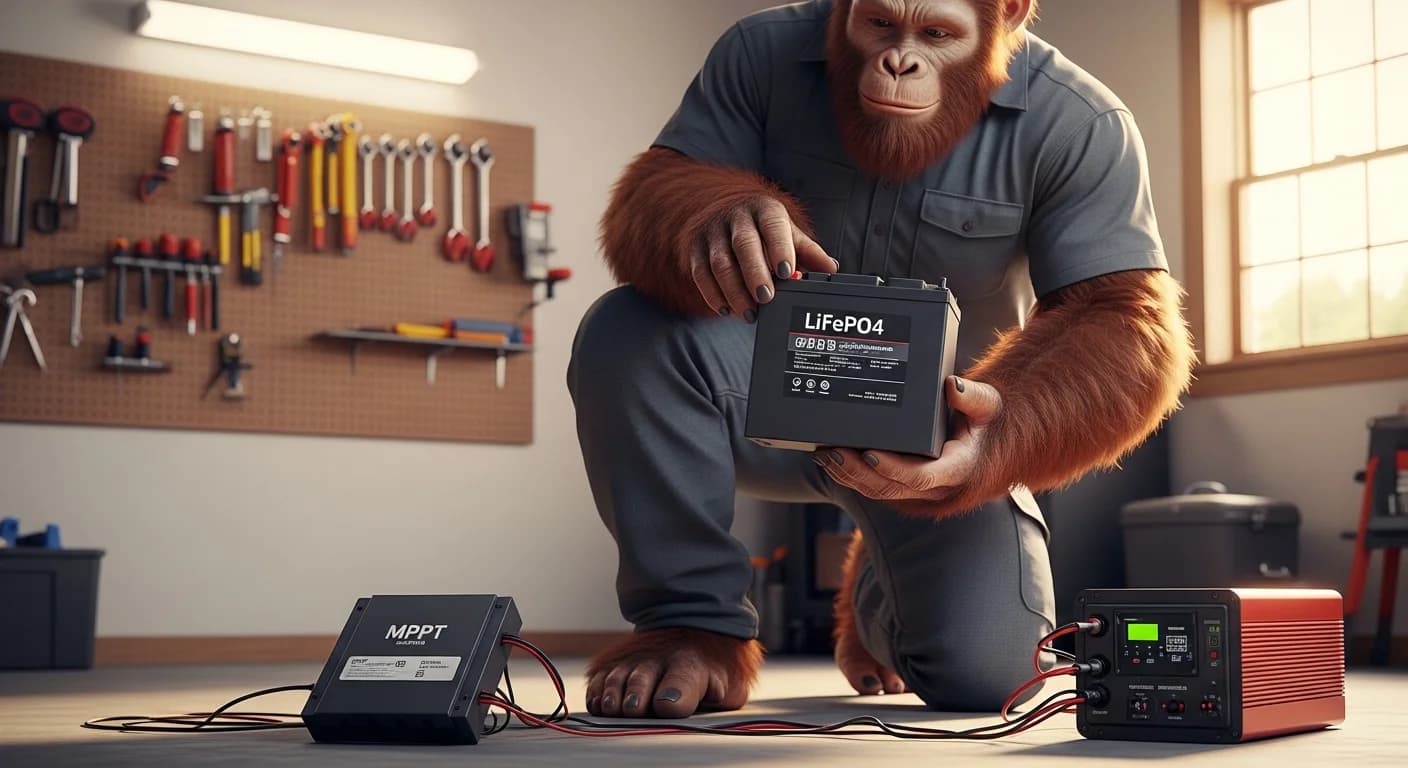
Solar Battery Backup: Why Grid-Tied Solar Fails in a Blackout
TL;DR — Quick Summary
Grid-tied solar shuts down during blackouts. That is not a flaw — it is a federal safety requirement. Solar battery backup adds the storage and the inverter intelligence that allow your home to "island" itself off the grid and keep running. This guide explains why standard solar fails, what backup options work, how to size a battery bank to your actual loads, and the cost math that decides whether 10 kWh, 20 kWh, or 40 kWh is right for your situation.
The valley went dark at 3:17 in the morning.
A pole transformer blew somewhere up the line. The first thing Duke heard was his own silence — the refrigerator, the well pump, the ceiling fan all stopping at once. The kind of quiet a modern house never has.
Duke checked his phone. Power company outage map: red across four counties. Estimated restoration: twelve hours.
He walked outside in his slippers. Looked across the road. His neighbor Frank had a 12 kW solar array on his south-facing roof, installed two summers ago by a reputable contractor. Frank was proud of that system. He talked about it at every cookout.
Frank's house was completely dark.
Duke's house, a hundred feet away, was running. Living room lamp glowing. Refrigerator humming. Coffee maker warming up because Duke set a timer the night before and the timer didn't know the grid had failed.
The difference between the two houses wasn't the solar panels. Frank had more panels than Duke. The difference was the four LiFePO4 batteries in Duke's garage and the hybrid inverter that knew what to do when the grid disappeared.
By morning, Frank was loading frozen meat into a cooler with melting ice from the gas station. Duke was on his second cup of coffee.
Same neighborhood. Same storm. Same solar industry. Two completely different outcomes.
The piece Frank was missing has a name. Solar battery backup.
Who This Is For
This guide is for the homeowner outside Houston who installed grid-tied solar in 2022 and learned during the first hurricane that the panels did nothing. The retired couple in suburban Phoenix watching summer blackouts stretch from two hours to twelve. The wildfire-zone family in El Dorado County under public safety power shutoff orders for three days at a stretch. The Florida homeowner in Cape Coral who's done two hurricanes since the panels went up and lost food in both. The Texas family who survived the 2021 freeze on a generator and swore they'd never do that again. The veteran on a fixed income in rural Tennessee whose insurance company just dropped him because of grid instability.
For years, the solar industry told homeowners that grid-tied was enough.
For years, installers buried the blackout problem in fine print.
For years, batteries were called "optional."
The grid finally answered that question for everyone.
This guide is for the homeowner who already has panels and is wondering why they're useless during outages. It's also for the homeowner who hasn't installed yet and wants to do it right the first time.
Why Grid-Tied Solar Fails During a Blackout
The hardest thing to accept about grid-tied solar is that the panels work fine — the system just refuses to let you use the power. The only fix is solar battery backup.
When the utility loses power, your grid-tied inverter detects the loss and shuts itself down within seconds. This is called anti-islanding protection and it is required by IEEE 1547 and UL 1741 standards. Every grid-tied inverter sold in the United States does this. There is no override.
The reason is a line worker safety issue. If thousands of homes back-fed power into a "dead" grid during an outage, repair crews could be electrocuted by the wires they were trying to fix. So every grid-tied inverter is required to disconnect the moment it detects the grid is gone.
Result: 28 panels on your roof produce nothing during the outage. Your $25,000 system becomes a very expensive set of shingles for the duration. Without solar battery backup, there is no workaround.
The only way to keep solar working during a blackout is to add the two components that make solar battery backup possible:
- A battery bank that stores energy locally so you have something to power your home with
- An inverter that can island — either a hybrid inverter or an off-grid inverter with grid-interactive features — that disconnects from the dead utility and creates its own local AC grid powered from the batteries
Together, these turn your grid-tied solar from a fair-weather investment into a working solar battery backup system.
🦍 WATTSON'S BACKUP TRUTH: "Panels alone are not a backup."
I have stood in too many garages explaining to too many homeowners why their $30,000 solar array did not keep their freezer running through a three-day outage. The installer never said the word "anti-islanding" out loud. The brochure showed a happy family with the lights on during a storm. The contract did not. Solar without battery backup is a fuel-savings tool. Solar with battery backup is a blackout-proof home. Different products. Different prices. Different outcomes. Trust the sasquatch on this one.
The Three Paths to Solar Battery Backup
There are three real approaches to solar battery backup. Each one fits a different starting point.
Path 1: All-In-One Hybrid Inverter (Best for New Installs)
A hybrid inverter handles solar input, battery charging, grid interconnection, and islanding in one box — the most integrated solar battery backup setup available. Wire panels and batteries to it. Wire the output to your main panel through an automatic transfer switch. Done.
The hybrid approach is the cleanest install if you're starting from scratch. One box, one warranty, one set of monitoring software.
Common units in this category:
- Sol-Ark 12K — 12 kW continuous output, automatic failover, well-regarded in off-grid forums
- EG4 18kPV — Budget-friendly hybrid with 12 kW continuous and broad battery compatibility
- Schneider XW Pro — Long-running pro-grade option for whole-home backup
Best for: New solar installations, homeowners doing a deep retrofit, anyone replacing a failed inverter.
Path 2: AC-Coupled Retrofit (Best for Existing Solar)
If you already have grid-tied solar working, an AC-coupled solar battery backup system bolts on without changing your panels or your existing inverter. The new battery system has its own grid-forming inverter that synchronizes with your existing solar.
This is the path Tesla Powerwall, Enphase IQ Battery, and similar solar battery backup products take.
- Tesla Powerwall 3 — 13.5 kWh per unit, stackable to 40+ kWh, includes integrated inverter
- Enphase IQ Battery 5P — Best for systems already running Enphase microinverters
- Franklin WH — Newer entry, strong specs for whole-home loads
Best for: Homeowners who already have grid-tied solar and want backup without ripping out the existing system.
Path 3: Full Off-Grid System (Best for Independence-First Homes)
A separate off-grid system runs in parallel with the grid (or replaces it entirely). The off-grid system handles critical loads through a sub-panel. The grid runs everything else, or nothing at all.
This is the approach for cabins, homesteads, and homes where energy independence is the actual goal — not just backup.
- Victron MultiPlus-II + LiFePO4 server-rack batteries — Industry-standard combination, infinitely tunable
- OutBack Radian — Built for harsh climates and remote installs
Best for: Off-grid cabins, rural homesteads, anyone whose plan is to disconnect from utilities permanently.
How to Size Your Solar Battery Bank
Sizing solar battery backup is where most homeowners go wrong. They oversize because a salesperson sold them comfort, or they undersize because they ran the math on a calm Tuesday instead of a four-day storm.
The National Renewable Energy Laboratory has published load-modeling research showing that most US homes can cover 90% of outage hours with 10-15 kWh of storage if loads are managed. The honest way to size your solar battery backup is to start with what you actually need to keep running.
Step 1: List Your Critical Loads
Walk through your house. Write down every device that has to stay on during an outage. For most homes, the critical list is:
- Refrigerator (150–400 W running, surge briefly higher)
- Chest freezer (100–300 W)
- Well pump (750–1,500 W running, 3x that on startup surge)
- Internet router and modem (20–50 W)
- A few LED lights (5–15 W each)
- Phone and laptop charging (10–60 W)
- Furnace blower or central heat pump (300–2,000 W depending on system)
- Window AC if summer outages matter (500–1,500 W)
- Medical equipment if applicable
Skip the dryer, the oven, the EV charger, the hot tub. Those are luxuries during a blackout. Heat them with propane, cook on a Coleman stove, charge the car at the office.
Step 2: Calculate Daily Watt-Hours
For each critical load, multiply watts by hours of expected daily use.
Example: A fridge at 200 W running roughly 8 hours a day (it cycles on and off) = 1,600 Wh per day.
Add it all up. A typical critical-loads list lands between 4,000 Wh and 8,000 Wh per day.
Step 3: Multiply by Backup Days
How many cloudy or stormy days do you need to bridge with no solar input?
- One day: light hedging for short outages
- Two days: realistic for most regions
- Three days: hurricane zones, mountain weather, northern latitudes
- Four+ days: extreme preparedness
Step 4: Apply Depth of Discharge
LiFePO4 batteries handle 80% depth of discharge safely. Divide your total by 0.8 to get nameplate capacity needed.
Worked example: 5,000 Wh daily × 2 backup days ÷ 0.8 DoD = 12,500 Wh = 12.5 kWh nameplate.
Round up to the next standard size. That's a 13.5 kWh Powerwall, two 6 kWh server-rack batteries, or three 5 kWh wall-mount units.
Quick Sizing Guide
| Use Case | Battery Size | What It Covers |
|---|---|---|
| Essentials only | 10 kWh | Fridge, freezer, lights, internet, phones — 24 hours |
| Comfortable | 20 kWh | Essentials + well pump + medical + small AC — 36 to 48 hours |
| Whole home | 40 kWh+ | Most loads including heat pump or central AC — 2 to 3 days |
Solar recharges the bank daily. You're not storing a week of power. You're storing enough to bridge from sunset to sunrise plus a margin for storm days.
The Real Cost Comparison
The honest cost question is not "solar battery backup vs no solar battery backup." It is "solar battery backup vs the cumulative cost of being unprepared."
| Cost Factor | Grid-Tied Only | With Battery Backup |
|---|---|---|
| System cost | $20,000–30,000 | $30,000–50,000 |
| Outage protection | None | Full |
| Food spoilage per major outage | $500–2,000 | $0 |
| Generator fuel for typical 3-day outage | $50–200 | $0 |
| Hotel costs if outage extends | $300–600 | $0 |
| Insulin and medication losses | Possible | $0 |
| Peace of mind during storms | Anxiety | Sleep through it |
According to the U.S. Department of Energy, residential battery storage is increasingly cost-effective as both lithium prices and outage frequency move in opposite directions.
One extended outage with lost food, lost work-from-home productivity, and a hotel stay can easily cost $1,500–3,000. Two or three of those over the life of a solar system and the battery backup has paid for itself in pure outage avoidance — separate from the daily solar savings.
🦍 WATTSON'S COST MATH: "Compare to 25 years, not 25 days."
Most homeowners compare battery cost to one month's electric bill. Wrong calculation. Compare it to 25 years of rate hikes, plus inflation, plus every blackout that's coming, plus the food in your fridge, plus the sleep you'll lose worrying every time the wind picks up. Battery backup is not an expense. It is insurance with a return on investment. The contractor who undersized my system in 2011 cost me $15,000. The batteries I bought to replace what he sold me have already saved me three times that. Math wins.
Panels. Batteries. Inverter. Charge controller.
Four components do all the work. Pick the wrong one and the whole system underperforms. The component guide walks specs that matter and specs that are marketing.
COMPARE COMPONENTS →Frequently Asked Questions
Why doesn't grid-tied solar work during blackouts? Federal safety standards require grid-tied inverters to shut down within seconds of detecting a grid outage. This prevents back-feeding power into utility lines and protects repair crews. Without batteries and an islanding-capable inverter, your panels produce nothing during an outage.
How much battery backup do I really need? For solar battery backup covering essentials (fridge, lights, internet, phones), 10 kWh covers about 24 hours. For comfort including a well pump and modest AC, plan on 20 kWh. For whole-home backup with central HVAC, 40 kWh or more. Match the size to your actual critical loads, not to a salesperson's recommendation.
Can I add batteries to my existing grid-tied solar system? Yes. AC-coupled retrofit solar battery backup like Tesla Powerwall or Enphase IQ Battery work with most existing grid-tied installations without replacing your panels or original inverter. Expect $10,000–20,000 for a retrofit depending on system size.
Is a Tesla Powerwall worth it compared to other batteries? Powerwall has the strongest brand recognition and tight installer network, but it costs more per kWh than server-rack LiFePO4 alternatives. For DIYers and budget-conscious homeowners, EG4, SOK, and Big Battery offer 70-80% of the performance at 50-60% of the cost. For homeowners who want a single-vendor solution with professional install, Powerwall is the path of least resistance.
How long will battery backup last during an outage? Depends on bank size and loads. A 20 kWh bank running 1 kW of continuous loads lasts about 16 hours on stored energy alone. With daytime solar recharging, the bank refills each day and can run indefinitely on managed consumption — that's the whole point.
Do hybrid inverters require new wiring? A new hybrid inverter typically requires a dedicated subpanel for critical loads, an automatic transfer switch, and conduit between the panel and the battery bank. Most installs take a licensed electrician 1–2 days for the electrical work plus inspection.
What's the difference between AC-coupled and DC-coupled batteries? DC-coupled batteries connect directly to the same charge controller that handles your panels — slightly more efficient, requires planning at install. AC-coupled batteries have their own inverter and bolt on to existing grid-tied solar — simpler retrofit, slightly lower round-trip efficiency. For new installs, DC-coupled wins. For retrofits, AC-coupled wins.
Will battery backup pay for itself? On daily energy savings alone, payback is typically 8–15 years depending on local electricity rates. Add the cost-avoidance of even one major outage every two years (food spoilage, generator fuel, hotel costs, medication losses) and payback drops to 5–8 years.
Can battery backup run an electric heat pump? Yes, but it requires a large bank. A modern variable-speed heat pump pulls 1.5–4 kW continuously in extreme weather. Running a heat pump for 12 hours overnight on batteries alone needs 20–50 kWh of storage. Most homeowners size for "heat pump survival" rather than "heat pump comfort" during outages — set the thermostat to 60°F instead of 72°F.
Are there tax credits for adding battery backup? Yes. The federal Residential Clean Energy Credit covers 30% of the cost of solar plus battery storage through 2032. Many states add additional incentives. Standalone battery additions (without new solar) became eligible for the 30% credit starting in 2023.
Conclusion
Solar battery backup is the difference between a roof full of panels and a home that actually works in a blackout. Grid-tied solar alone leaves you in the dark by federal mandate. Solar battery backup turns the same panels into a working power plant that runs your fridge, your well pump, and your peace of mind.
Three paths to solar battery backup. Hybrid inverter for new installs. AC-coupled retrofit for existing solar. Full off-grid for homes that want independence. Size for your real critical loads, not a salesperson's brochure. Start at 10 kWh for essentials, plan on 20 kWh for comfort, build to 40+ kWh for whole-home coverage.
The next outage is coming. Be the house with the lights on.
Related Resources
- Solar Batteries for Off-Grid: What Lasts vs What Fails
- Component Selection Guide (Pillar 4 Hub)
- Battery Bank Sizing: How Much Storage Do You Actually Need?
- Lithium vs Lead Acid Batteries: The Ultimate Showdown
- How to Set Up an Off-Grid Solar Power System
Wattson is Solar Trained at the US Solar Institute, Florida. He has lived off-grid since 2011, after a contractor's undersized system melted his first battery bank and cost him $15,000. He rebuilt every piece himself. His utility bill has been zero for fourteen years.
Last updated: May 31, 2026