TL;DR - Why the inverter beeps and what to do about it
An inverter that beeps and shuts off is protecting itself from one of four things. A motor kicked on that needed two to three times the inverter's rated power (well pump, AC compressor, deep freezer compressor at startup). Too many appliances were running at the same time and the total added up past the inverter's continuous rating. The inverter overheated from blocked vents, dust, or hot weather. The battery voltage dropped below the inverter's cutoff while it was trying to deliver power. Listen to when the beep happens. That tells you which of the four is the cause. The fix matches the cause - either a bigger inverter, smarter scheduling of what runs together, better ventilation, or a battery fix.
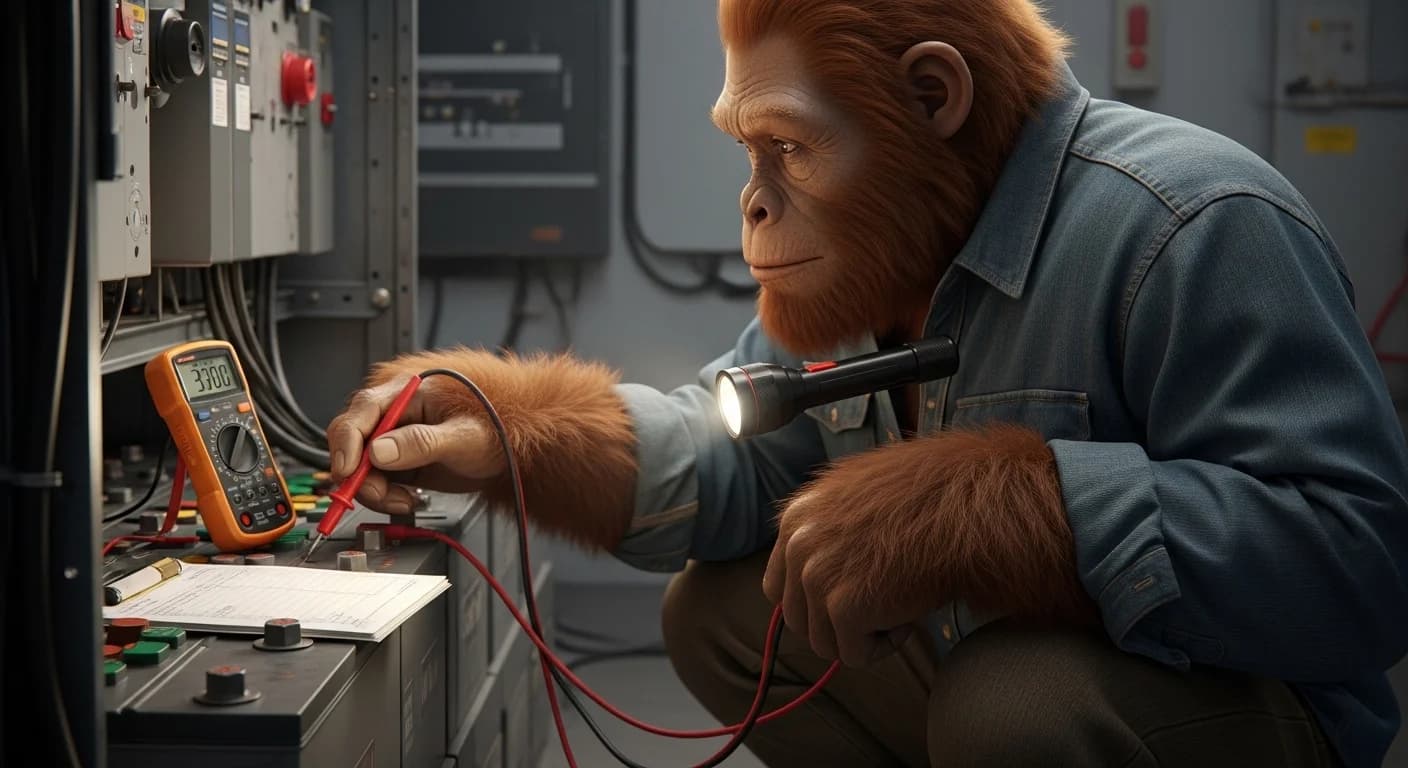
He was on his porch in late June, Wyoming, when the freezer alarm went off in the kitchen. He walked inside and heard the inverter doing the long beep - three notes, then silence. Power was out in the whole house. He hit the reset and the system came back. Two hours later, same thing. The well pump kicked on for the afternoon irrigation and the inverter cut out. The next day he called his installer and got told he needed a bigger inverter. $3,400 quoted. He almost wrote the check. Then he called a US Solar Institute trained tech who said hold on, before you spend that money let me come look. The tech showed up with a clamp meter and watched the system for an hour. Two things were happening at once. The well pump pulled 4,800 watts on startup - his 5,000-watt inverter could barely handle it on a good day. And the inverter was mounted in a metal closet that hit 118 degrees F by mid-afternoon, which dropped its effective capacity by another 20 percent. So a 5,000-watt inverter was trying to deliver 4,000 watts of actual capacity to a load that needed 4,800. It was tripping on overload because it physically couldn't make the watts. The tech moved the inverter to a cooler spot in the basement, added two computer fans for $40 of airflow, and that was the whole fix. No new inverter. The system ran four more years with no trouble. The installer had been ready to sell him a $3,400 solution to a $40 problem.
Who this is for
This guide is for the Wyoming homesteader whose well pump trips the inverter every afternoon in summer and who's been told he needs to spend $3,400 on a bigger one. The Florida retiree whose AC unit kicks on at noon and shuts down half the breakers in the house. The Vermont cabin owner whose deep freezer compressor cycles on at 3 AM and wakes him up to the beep every other night. The Arizona homesteader whose inverter sits in a metal shed that hits 130 degrees F by mid-afternoon and trips on overheat instead of overload. The Texas family who plugged in a space heater on a cold morning and watched the whole system shut down within ninety seconds. The Colorado mountain homeowner whose system worked perfectly all summer and started failing every cold morning in November when the batteries get sluggish. The Pennsylvania DIYer who built his own system, sized for his current loads, and just bought a welder he forgot to factor in. The Oregon off-gridder whose ground-mount system delivers fine on sunny days and trips when clouds reduce the available power.
Three things are true of every one of them.
The inverter isn't broken. It's saying "this is more than I can do."
The fix usually isn't a bigger inverter. The fix is figuring out which one of four problems is happening.
Spending $3,400 to replace a $40 problem is the most expensive mistake in off-grid solar.
What an inverter overload alarm is actually telling you
Every inverter has built-in protection that shuts it down before something breaks. The beep is a fault signal, not a death rattle. The inverter is saying "I detected a condition that would damage me or the batteries if I kept running, so I cut power until you figure out what's wrong."
This protection is a feature, not a problem. Without it, an overloaded inverter would burn out its power transistors and need replacement instead of just resetting. The beep is the inverter saving itself.
Now the question is what specifically tripped the protection. Inverters trip for four main reasons. The pattern of when the beep happens tells you which one.
Reason 1: Surge overload. A motor or compressor kicked on. Motors pull two to three times their running watts during the half-second they start up. A refrigerator that runs at 200 watts can demand 600 watts during startup. A well pump that runs at 1,500 watts can demand 4,500 watts. If your inverter is rated for less than the surge, it trips the moment the motor starts.
Reason 2: Continuous overload. Too many things running at once. The total watts being pulled exceeded what the inverter is rated to deliver continuously. Usually happens at predictable times - everyone in the house turning on appliances around dinner, or running the AC while the oven is heating.
Reason 3: Overheating. The inverter case got too hot. Usually because of blocked vents, dust buildup, hot ambient air, or the inverter being mounted somewhere with no airflow. Inverters lose capacity as they heat up. A 5,000-watt inverter rated at 77 degrees F can only deliver maybe 4,000 watts at 120 degrees F.
Reason 4: Low battery voltage. The batteries dropped below the inverter's cutoff voltage. Sometimes from being genuinely low, sometimes from a wiring problem that makes the inverter see lower voltage than the batteries actually have, sometimes from cold weather making the batteries deliver less voltage under load.
The 80/20 rule applies. Across thousands of off-grid systems, those four causes account for about 95 percent of inverter overload events. Diagnose which one is happening, fix that, the beeping stops.
WATTSON'S OVERLOAD TRUTH: At the US Solar Institute the instructor put it as plain as anyone ever has. "The inverter never lies. It tells you exactly what it can't do and exactly when. If you're not listening to when it beeps, you're going to keep buying parts you don't need." That stuck with me. In fifteen years off-grid I've had two false alarms from actual inverter defects. Every other beep was the inverter doing exactly what it was supposed to do, telling me something else in the system needed attention. The well pump needed a soft starter. The freezer was old and pulling more surge than it used to. The vents had filled with dust. The batteries were cold. Listen to when. The when is the whole answer.
Stop guessing why the inverter keeps shutting off.
Wattson's Inverter Load Worksheet - the simple worksheet that adds up what you actually run, calculates the surge spikes, and tells you whether your inverter is too small or the problem is something else.
GET THE WORKSHEET ->The "when" diagnosis for inverter overload
The single most useful diagnostic question is "when does the beep happen?" Match the timing to the cause.
"It beeps the moment I turn on [specific appliance]"
That appliance is pulling more surge than the inverter can deliver. The fix is either a soft-start kit on the appliance (most common solution for well pumps and AC units), or sizing up the inverter, or running that appliance at a different time so the surge doesn't catch other loads.
Surge culprits, ranked by how often they cause this:
- Well pump - typically 3-4x running watts on startup
- AC compressor - 2-3x running watts
- Deep freezer or refrigerator after defrost cycle - up to 6x running watts (the worst surge load in most homes)
- Power tools with brushed motors - 2-3x running watts
- Window AC units - 2-3x running watts
If you don't know which appliance is the surge culprit, run a process of elimination. Turn the inverter on with everything off. Add one appliance at a time. The one that trips the beep is the one with the surge.
"It beeps when I have several things running"
The continuous load is exceeding the inverter's rating. You need to add up actual watts being drawn at the moment of trip. Most beeps happen at predictable times - dinner cooking, morning rush, summer afternoon AC + cooking.
A typical household pulls these continuous wattages:
- Refrigerator running: 100-200 watts
- Microwave: 1,000-1,500 watts
- Coffee maker: 800-1,200 watts
- Toaster: 800-1,000 watts
- TV: 50-200 watts
- Computer or laptop: 50-200 watts
- LED lighting (whole house): 100-300 watts
Add it up. A 3,000-watt inverter can handle two big-draw items at once but not three. If you're running the microwave, coffee maker, and toaster all at the same time you've already passed 3,000 watts before you count the fridge and lights.
Fix is either staggering when high-draw items run, or sizing up the inverter, or upgrading individual appliances to lower-draw versions.
"It beeps after running for an hour or two, especially when it's hot"
Overheating. The inverter case temperature has climbed past the safe cutoff.
Check these in order:
- Are the vents on the inverter clear? Dust, spider webs, leaves - clean every vent with compressed air.
- Is there at least 6 inches of clearance around the inverter on all sides? Inverters need to breathe.
- What's the ambient temperature where the inverter is mounted? If it's above 100 degrees F in the equipment space, you have a heat problem. Move the inverter, add ventilation, or put a fan on it.
- Are the heatsink fins (the metal ridges on the back or sides) coated in dust? Wipe them down with a dry rag.
A 3,000-watt inverter generates 150-300 watts of heat at full load. That heat has to go somewhere. If it can't escape the equipment space, the inverter eventually heats itself into shutdown.
"It beeps when the batteries are low or cold"
Low DC input voltage. The inverter shuts off below a certain voltage to protect the batteries from over-discharge.
Check three things:
- What's the actual battery voltage at the inverter terminals when the trip happens? If it's below the inverter's cutoff (typically 10.5V on a 12V system, 21V on a 24V, 42V on a 48V), the batteries are genuinely low and need recharging.
- What's the battery voltage at the battery terminals versus at the inverter input? If the inverter reads 1V or more lower than the battery, you have a voltage drop problem in the cable run - probably a loose connection, undersized cable, or corroded terminal. See loose terminal heating for the fix.
- Are the batteries cold? Below 32 degrees F, batteries deliver less voltage under load even when they're charged. Insulate the battery space or add a thermostat-controlled heater.
Why surge ratings matter more than continuous watts for inverter overload
The single most-misunderstood spec on an inverter label is surge rating. Most homeowners look at the continuous watts number and ignore the surge number. Then they wonder why a "5,000 watt" inverter trips when running 3,000 watts of appliances.
Here's how it actually works. An inverter has two ratings.
Continuous rating: how many watts the inverter can deliver indefinitely without overheating. This is the number on the front of the unit. 3,000W, 5,000W, 8,000W, etc.
Surge rating: how many watts the inverter can deliver for a few seconds during a startup spike. Usually 1.5x to 2x the continuous rating on high-frequency inverters, 2x to 3x on transformer-based inverters.
Motors don't ask politely for power. When a motor starts, it demands the surge wattage instantly. If your inverter's surge rating is below the motor's surge demand, the inverter trips.
A 5,000W continuous / 10,000W surge inverter can handle a well pump that needs 4,500W to start. A 5,000W continuous / 7,500W surge inverter cannot. Both inverters say "5,000W" on the front. Only the surge rating tells you whether it'll actually work.
The general rule: your inverter's surge rating should exceed the biggest single startup load you have plus the continuous loads already running when that startup happens. If your well pump surges to 4,500W and your fridge, lights, and TV are pulling 600W when it starts, you need a surge rating above 5,100W.
According to U.S. Department of Energy guidance on residential inverter sizing, inverters undersized for surge loads are one of the most common causes of premature off-grid system failures. The fix is usually selecting a transformer-based inverter (heavier, more expensive, better at handling motor startup) instead of a high-frequency inverter (lighter, cheaper, less surge tolerance).
When to size up vs fix the inverter overload another way
Replacing the inverter is usually the wrong first move, even when overload is the diagnosis. Try these cheaper fixes first.
Soft-start kit on the surge culprit ($60-200). A soft-start kit reduces the startup current of a motor by 60-70 percent. Most useful for well pumps, AC compressors, and any motor over 1HP. Installs in 30 minutes for most well pumps. Lets a 5,000W inverter handle a pump that previously needed 8,000W to start.
Better scheduling ($0). Run the dishwasher at 10 AM instead of 6 PM when the lights and TV are off. Stagger the toaster and coffee maker. Don't run the microwave and AC at the same time. Most overload patterns are predictable and avoidable.
Improve ventilation ($20-200). Move the inverter to a cooler space. Add a thermostat-controlled fan. Clean the vents quarterly. Many "undersized inverter" problems are actually "underventilated inverter" problems.
Upgrade individual appliances ($100-2,000). A 1990s deep freezer pulls 4x the watts of a current Energy Star unit. Sometimes the cheaper fix is replacing the one offender instead of the inverter.
Only after those four fixes are exhausted does a bigger inverter make sense. When you do size up, look for transformer-based units (Victron MultiPlus, Outback, Schneider) over high-frequency inverters - they handle surge loads dramatically better at the same continuous rating.
When to stop and call a pro
Stop immediately and call a licensed solar electrician if any of these conditions are present.
- You smell burning plastic or electrical insulation near the inverter
- Smoke visible from any vent or seam on the inverter case
- The inverter case is too hot to touch on its outer surface
- The inverter throws a different error code with each restart (suggests internal damage)
- You see scorch marks around the AC output terminals or DC input lugs
- The inverter draws DC current from the batteries even when AC output is zero (parasitic short)
- You feel a tingle when touching the inverter case or any cable going to or from it
- The AC output voltage is reading wildly wrong (under 100V or over 130V on a 120V system)
These conditions mean the inverter has a hardware failure that no amount of load reduction will fix. Open the DC disconnect, disconnect AC loads, and call a US Solar Institute trained tech or licensed electrician.
Frequently asked questions
My inverter is rated 5,000W and I'm only running 3,000W of appliances. Why does it beep? Almost certainly a motor surge issue. Continuous watts is the easy math but surge is the hard math. A motor that runs at 800W can demand 2,400W during the half-second it starts. If you have three motors that all surge simultaneously - say, well pump, fridge compressor, and AC kicking on at the same moment - the surge can easily exceed 5,000W even though continuous draw is well under.
Should I just buy a bigger inverter? Not as the first move. Try a soft-start kit on the biggest surge load, better scheduling of what runs together, and improved ventilation. Those three fixes solve the overload problem in most homes for less than $300 total. A bigger inverter is the right answer only when those don't work.
How can I tell which appliance is causing the inverter overload? Process of elimination. Start with the inverter on and everything off. Add one appliance at a time, write down at what point the inverter trips. Whatever you added last is your surge or load culprit. A clamp meter on the DC cable to the inverter shows exact current draw if you want precise numbers.
What's a soft-start kit and where do I get one? A soft-start kit is a device that reduces the startup current of a motor by ramping power up gradually instead of all-at-once. They install in series with the motor. The most common brands are Hyper Engineering (for well pumps) and Micro-Air EasyStart (for AC compressors). Cost is typically $200-400. Best off-grid investment you can make if you have a motor that's surging your inverter.
My inverter trips every cold morning. What's going on? Cold batteries deliver less voltage under load. Even healthy batteries can drop below the inverter's cutoff voltage in freezing weather, especially with a high startup load. The fix is insulating the battery compartment, adding a thermostat-controlled heater (heated battery pads are $50-150), or upgrading to LiFePO4 batteries with built-in heating circuits.
The inverter beeps but doesn't shut off completely. Is that different? Yes. A continuous beep without shutdown usually means the inverter is operating near its limit but hasn't yet exceeded it. Common causes: high but not over-limit load, slightly elevated temperature, or marginal battery voltage. Don't ignore it - it's a warning that you're one extra appliance away from a full trip.
How long should I wait between resetting the inverter and trying again? At least five minutes for overheat trips - the inverter needs time for internal temperatures to drop and capacitors to discharge. For overload trips, just a few seconds. For low-voltage trips, wait until the batteries are charged enough to start the inverter again.
Can I run my inverter at 100 percent of its rated capacity all the time? No. Never run an inverter above 80 percent of its continuous rating for extended periods. Heat generation increases exponentially above that threshold. An inverter running at 90 percent capacity for hours will trip on overheat or burn out its components prematurely. Size with headroom.
Why does my inverter shut down only when the well pump kicks on? Surge overload. The well pump is demanding more wattage at startup than your inverter can deliver in a brief burst. Options in order of cost: install a soft-start kit on the pump ($200-400), upgrade to a transformer-based inverter with higher surge rating, or upgrade to a higher-continuous-rated inverter. The soft-start kit is almost always the right first move.
Does running an inverter at low load damage it? No. Inverters are happy running at 10-50 percent of capacity. The damage threshold is on the high end, not the low end. A 5,000W inverter pulling 500W indefinitely is operating well within spec and will last its full design life.
My inverter is in a hot attic. Will moving it solve my inverter overload trips? Probably partially. An inverter loses about 1-2 percent of its rated capacity for every 10 degrees F above 77 degrees F ambient temperature. An attic that hits 130 degrees F in summer effectively de-rates your inverter by 10-15 percent. Move it to a basement, closet, or cooler space, and you regain that capacity. Combined with vent cleaning and added airflow, the move often solves overload problems without other intervention.
How do I know if my inverter is actually failing versus just overloading? A failing inverter shows symptoms that don't correlate with load. The beep happens at random times, the AC output voltage drifts (reading 105V or 130V instead of 120V), or it throws different error codes each time. An inverter overload event happens in predictable patterns tied to specific loads or times of day. Pattern means inverter overload. Random means hardware failure.
Conclusion
An inverter overload beep is the inverter doing its job, not failing at it. The inverter detected that something exceeded its safe operating limits and shut down to prevent damage. The beep is the warning.
Four causes account for nearly every inverter overload event. A motor surge that demanded more wattage than the inverter can deliver in a brief burst. A continuous load that summed past the inverter's rating. An overheating case that de-rated the inverter below the load it's trying to deliver. A battery voltage that dropped below the inverter's safety cutoff.
Listen to when the beep happens. The timing tells you which of the four. The fix matches the cause. A soft-start kit for surge problems. Smarter scheduling for continuous overloads. Better ventilation for overheating. A battery fix for voltage issues.
Don't buy a bigger inverter as the first move. Try the cheap fixes first. The most expensive mistake in off-grid solar is replacing a $5,000 inverter when a $200 soft-start kit would have solved the problem.
The complete Maintenance and Troubleshooting guide ->